
27°C
Gombak
Batu Caves Sri Subramaniar Swamy Temple
 Gombak, Selangor, Malaysia
Batu Caves is Malaysia’s most celebrated Hindu shrine, where Lord Murugan is worshipped inside a vast cave carved into 400-million-year-old limestone, reached by 272 rainbow-coloured steps.
- ReligionHindu
About the temple
About the temple
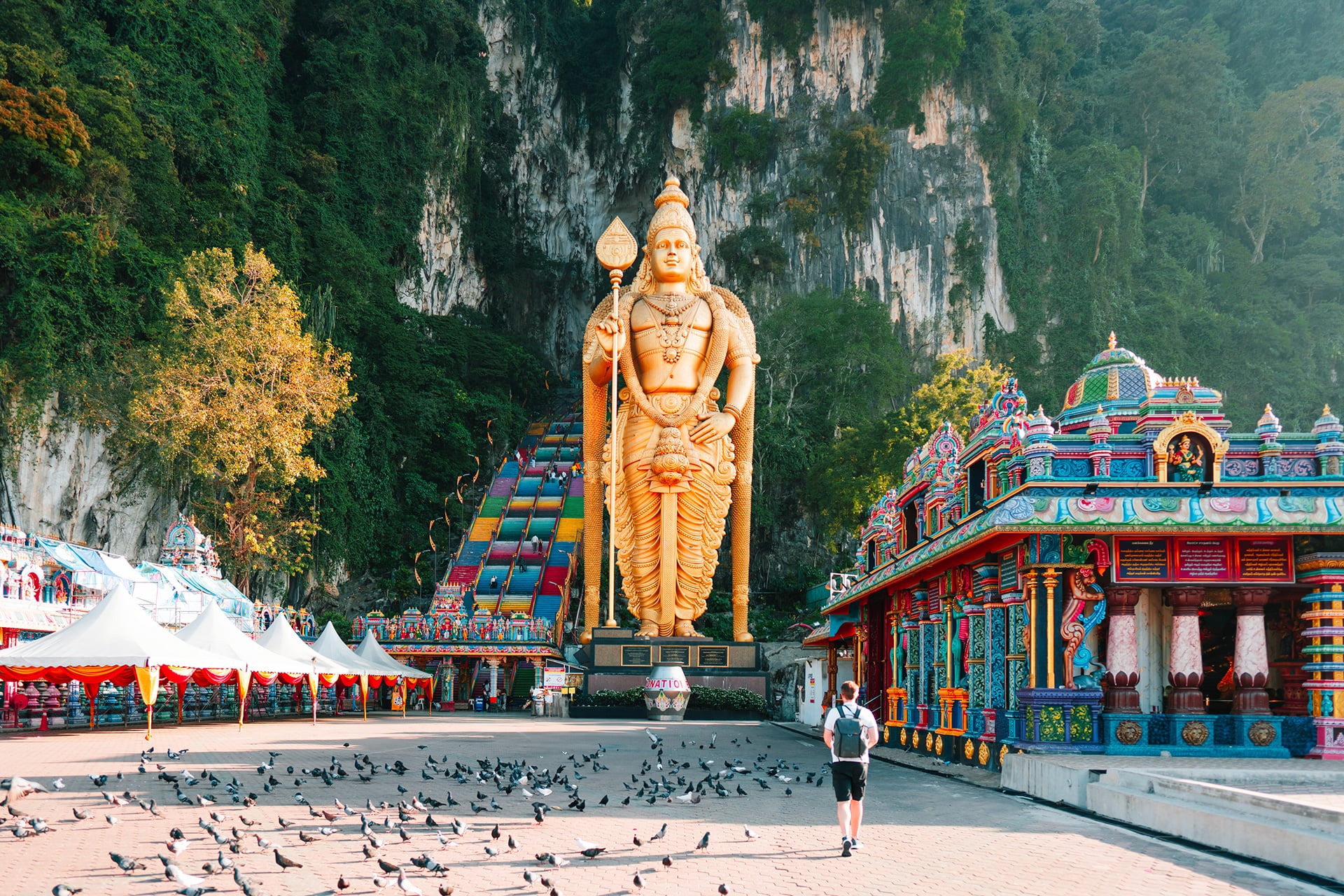
Batu Caves Sri Subramaniar Swamy Temple is the most famous Hindu temple in Malaysia and one of the most important shrines to Lord Murugan outside India. Set inside a vast limestone hill in Gombak, Selangor, about 13 km north of Kuala Lumpur, the main Temple Cave is reached by a flight of 272 steps and is guarded by a 42.7 m (140 ft) gold-painted statue of Lord Murugan unveiled in 2006. Worship at the caves was begun in the late 19th century by the Tamil community leader K. Thamboosamy Pillai, who saw the shape of Murugan's vel (divine spear) in the cave's entrance. Managed by the Sri Maha Mariamman Temple Devasthanam of Kuala Lumpur, Batu Caves is the centre of Malaysia's Thaipusam festival, which draws well over a million devotees and visitors each year.
Batu Caves Sri Subramaniar Swamy Temple
Batu Caves Sri Subramaniar Swamy Temple
The Sacred Legacy of Batu Caves Sri Subramaniar Swamy Temple in Numbers
Discover the natural history, devotion and landmarks of Batu Caves, Malaysia's most celebrated Murugan shrine. From its ancient limestone hill to its golden statue and the vast Thaipusam gatherings, these figures capture the scale and significance of the site.
- Estimated Age of the Batu Caves Limestone Hill
- 400+ million years
- Year the Sri Subramaniar Swamy Temple Was Established in the Cave
- 1891
- Steps Leading to the Temple Cave, Painted in Rainbow Colours in 2018
- 272
- Height of the Golden Lord Murugan Statue, Unveiled in 2006
- 42.7 m (140 ft)
- Gold Paint Used to Coat the Murugan Statue
- 300 litres
- Height of the Hanuman Statue at the Ramayana Cave
- 15m
- Approximate Distance from Kuala Lumpur City Centre
- 13km
- Approximate Route of the Thaipusam Silver Chariot Procession from Kuala Lumpur
- 15km
- Devotees and Visitors During the Thaipusam Festival Period
- 1 million+
- Approximate height of the Temple Cave’s ceiling.
- 100m
- Year the 272 concrete steps were completed.
- 1940
- Reported cost of the Murugan statue.
- RM2.5 million
- Species of bats recorded in the caves.
- 21
Estimated Age of the Batu Caves Limestone Hill
Year the Sri Subramaniar Swamy Temple Was Established in the Cave
Steps Leading to the Temple Cave, Painted in Rainbow Colours in 2018
Height of the Golden Lord Murugan Statue, Unveiled in 2006
Gold Paint Used to Coat the Murugan Statue
Height of the Hanuman Statue at the Ramayana Cave
Approximate Distance from Kuala Lumpur City Centre
Approximate Route of the Thaipusam Silver Chariot Procession from Kuala Lumpur
Devotees and Visitors During the Thaipusam Festival Period
Approximate height of the Temple Cave’s ceiling.
Year the 272 concrete steps were completed.
Reported cost of the Murugan statue.
Species of bats recorded in the caves.
Names & echoes
Echoes of a sacred place
Across languages, lands, and traditions, this shrine answers to many names — carried by pilgrims, locals, and stories far from its steps.
- Batu Caves
- Batu Malai
- Pathumalai
- Sri Subramaniar Swamy Temple
- Sri Subramaniam Temple
- Temple Cave
- Cathedral Cave
- Lord Murugan
- Subramaniar
- Kartikeya
- Skanda
- Thaipusam
- 272 Steps
- Golden Murugan Statue
- Kuala Lumpur
- Selangor
- Tamil Hindu Pilgrimage
Historical Background
Batu Caves Sri Subramaniar Swamy Temple in Gombak, Selangor, stands inside a limestone hill more than 400 million years old. The caves once sheltered the Temuan Orang Asli, and from the 1860s Chinese settlers dug guano there for fertiliser. American naturalist William Hornaday recorded the caves in 1878. In the late 1880s, K. Thamboosamy Pillai, founder of Kuala Lumpur’s Sri Maha Mariamman Temple, installed a vel in the main cave, inspired by the vel-like shape of its entrance. The temple dates to 1891, and Thaipusam has been celebrated there since 1892. The 272 concrete steps were completed in 1940, a Hanuman temple opened near the Ramayana Cave in 2001, the 42.7 m golden Murugan statue was unveiled in 2006, and the steps were painted in rainbow colours in 2018. Administered by the Sri Maha Mariamman Temple Devasthanam, the temple remains the centre of Thaipusam in Malaysia.
Over 400 million years ago
Over 400 million years ago
The limestone of the Batu Caves hill was formed; the hill is a tower karst (mogote) rising from the Gombak landscape.Before the 19th century
Before the 19th century
The caves were used as shelters by the Temuan, an Orang Asli (indigenous) people of the Malay Peninsula.1860s
1860s
Chinese settlers began collecting bat guano from the caves for use as fertiliser in vegetable farming.1878
1878
The American naturalist William Hornaday visited and recorded the caves, bringing them to wider attention.1888-1890
1888-1890
K. Thamboosamy Pillai, founder of the Sri Maha Mariamman Temple in Kuala Lumpur, installed a consecrated vel in the main cave, inspired by the vel-like shape of its entrance; sources give dates between 1888 and 1890.1891
1891
The Sri Subramaniar Swamy Temple was established in the cave with the consecration of Lord Murugan's shrine.1892
1892
The first Thaipusam celebration was held at Batu Caves.1920s-1930s
1920s-1930s
Wooden steps were built to the Temple Cave; a proposal for concrete steps was made in the 1930s.1940
1940
The 272 concrete steps to the Temple Cave were completed.November 2001
November 2001
A temple to Hanuman, with a 15 m statue, was consecrated near the Ramayana Cave.2003–2006
2003–2006
The 42.7 m (140 ft) Lord Murugan statue was built and unveiled on 29 January 2006, during Thaipusam.2010
2010
The rebuilt Batu Caves KTM Komuter station opened, giving direct rail access from Kuala Lumpur.August 2018
August 2018
The 272 steps were repainted in bright colours, drawing wide attention and a debate over the site's heritage status.2024
2024
The temple committee announced plans for an escalator on the side of the hill and a multipurpose hall and cultural centre; check the latest status before visiting.


Synopsis
Batu Caves Sri Subramaniar Swamy Temple in Gombak, Selangor, is a Hindu cave temple dedicated to Lord Murugan and the focal point of Thaipusam in Malaysia. The main shrine sits inside the Temple Cave of a limestone hill estimated to be over 400 million years old, reached by 272 colourful steps beside a 42.7 m golden Murugan statue. Established by K. Thamboosamy Pillai, with the temple dating to 1891, the complex also includes the Ramayana Cave, the Cave Villa and shrines to Vishnu, Shiva, Ganesha and the Navagrahas.
Batu Caves Sri Subramaniar Swamy Temple, dedicated to Lord Murugan, stands in the Temple Cave of a limestone hill in Gombak, Selangor, about 13 km north of Kuala Lumpur. The hill is estimated to be over 400 million years old, while Hindu worship at the site began in the late 19th century, making Batu Caves an unusual combination of an ancient natural landscape and a comparatively young but deeply revered shrine.
The caves were known to the Temuan Orang Asli and were mined for guano by Chinese settlers from the 1860s. They were recorded by the American naturalist William Hornaday in 1878. Temple accounts and Malaysian sources credit K. Thamboosamy Pillai with installing the vel in the cave in the late 1880s and establishing the temple in 1891, with Thaipusam first celebrated there in the early 1890s. Exact dates differ slightly between sources.
K. Thamboosamy Pillai (1850-1902), a prominent Tamil leader and founder of the Sri Maha Mariamman Temple in Kuala Lumpur, is regarded as the founder of the Batu Caves temple. The 272 concrete steps were built in 1940, following a proposal made in the 1930s. The golden Murugan statue (2006) was funded by the temple and devotees at a reported cost of about RM2.5 million.
Batu Caves is the most important Murugan shrine in Malaysia and one of the most visited Hindu sites outside India. It is the focus of the national Thaipusam celebration, when a silver chariot carries Lord Murugan's image about 15 km from the Sri Maha Mariamman Temple in Kuala Lumpur to the caves, and devotees fulfil vows by carrying kavadi and milk pots up the 272 steps.
The temple is administered by the Sri Maha Mariamman Temple Devasthanam. The site has been listed as a national heritage site, and the 2018 repainting of the steps prompted a public debate about heritage rules. The wider hill is ecologically important, with rare cave fauna such as the trapdoor spider Liphistius batuensis, and parts of the cave system are protected for conservation.
Sacred significance
The Foremost Murugan Shrine of Malaysia
Batu Caves is the most revered temple of Lord Murugan in Malaysia and one of the best-known Murugan shrines in the world. Worshipped here as Sri Subramaniar Swamy, Murugan is honoured as the deity of courage, wisdom and victory, and devotees from across Malaysia, Singapore, India and the wider Tamil diaspora visit to seek his blessings.
The Sacred Vel
Worship at Batu Caves began with the installation of a vel, Lord Murugan's divine spear, after the founder saw its shape in the cave's entrance. The vel represents divine wisdom that destroys ignorance, and it remains the central object of devotion at the shrine.
A Hill Abode of Lord Murugan
In Tamil tradition Murugan is closely associated with hills, and his most sacred shrines stand on hilltops. The climb up the limestone hill to the Temple Cave is itself an act of devotion, echoing the hill shrines of Palani and Tiruttani in Tamil Nadu.
Thaipusam - The Festival of the Vel
Batu Caves is the centre of Thaipusam in Malaysia, celebrated on the full-moon day of the Tamil month of Thai. The festival honours Murugan's receiving of the vel from Goddess Parvati, and devotees fulfil vows by carrying kavadi and milk pots (paal kudam) up the 272 steps.
Vows, Penance and Surrender
Many devotees prepare for Thaipusam through weeks of fasting, vegetarian diet, prayer and abstinence, often for 48 days. Carrying the kavadi, shaving the head or offering milk is understood as surrendering one's burdens to the Lord and giving thanks for prayers answered.
A Complex of Many Deities
Besides the Murugan shrine, the Batu Caves complex includes shrines to Lord Vishnu as Sri Venkatachalapathy with Alamelu (Lakshmi), Lord Shiva, Lord Ganesha, the Navagrahas and Hanuman, making it a place where devotees can worship several deities in one visit.
Architecture
Batu Caves is a cave temple rather than a built structure in the usual sense. The main shrine of Lord Murugan stands inside the Temple Cave (also called the Cathedral Cave), a vast natural chamber in a limestone hill, reached by a steep flight of 272 steps. The site combines natural limestone architecture with South Indian Dravidian-style shrines, painted sculptures, a colourful gopuram-style entrance at the cave mouth and monumental statues at the foot of the hill, most notably the 42.7 m golden statue of Lord Murugan.
Layout
Layout
The complex is spread along the foot and face of the limestone hill. The 272 steps lead from the forecourt to the Temple Cave, with the golden Murugan statue beside the stairway. At ground level are the Ramayana Cave with its Hanuman statue, the Cave Villa, and shrines to Vishnu, Shiva, Ganesha and the Navagrahas. The Dark Cave opens off the stairway partway up the hill.
Stairway
The 272 Rainbow Steps
The steep concrete stairway, completed in 1940, climbs to the Temple Cave. In 2018 the steps were painted in bright bands of colour, making them one of the most photographed staircases in Asia. The climb is itself an act of devotion, especially for devotees carrying kavadi or milk pots during Thaipusam.
Sanctum
Temple Cave (Cathedral Cave)
The main cave is a huge chamber with a very high ceiling (often described as around 100 m), with openings in the roof that let in daylight. It houses the principal shrine of Lord Murugan and other shrines, including one to his consorts Valli and Deivanai, set within the cave's inner and outer chambers.
Statue
Golden Lord Murugan Statue
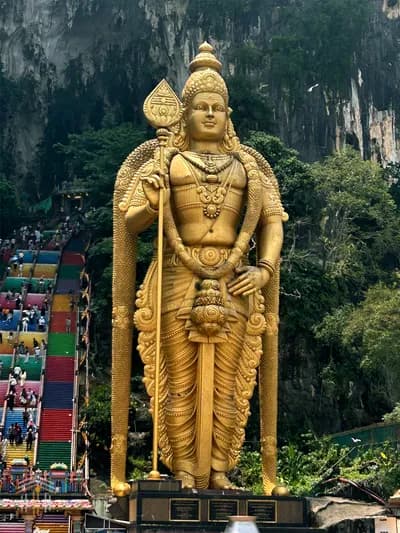
Unveiled on 29 January 2006, the 42.7 m (140 ft) statue stands beside the steps. It was built over about three years using some 1,550 cubic metres of concrete and about 350 tonnes of steel bars, and was coated with around 300 litres of gold paint. It is the tallest statue in Malaysia.
Statue
Hanuman Statue and Ramayana Cave
A 15 m (about 50 ft) green statue of Hanuman, with a Hanuman temple consecrated in November 2001, stands at the entrance to the Ramayana Cave. Inside, brightly painted and illuminated sculptures depict scenes from the Ramayana, including a giant sleeping Kumbhakarna.
Shrines
Base Shrines and Cave Villa
At the base of the hill are the Sri Venkatachalapathy and Alamelu (Lakshmi) temple, a Shiva shrine with Nataraja and Durga, a Ganesha shrine and a Navagraha shrine. The Cave Villa area contains painted murals and sculptures of Hindu deities and stories.
Geology
Limestone Hill and Cave System
The hill is a tower karst estimated to be over 400 million years old, with about 20 recognised caves. Its chambers contain stalactites, stalagmites, flowstones and cave pearls, and the Dark Cave is known for its delicate formations and rare cave fauna.
Interesting facts

The temple owes its origin to K. Thamboosamy Pillai, who saw the shape of Lord Murugan's vel in the entrance of the main cave. He placed a consecrated vel inside, beginning worship at the site in the late 19th century.
Deities & Shrines
Valli and Deivanai
Lord Murugan's two consorts, Valli and Deivanai, are honoured in a shrine within the Temple Cave. Devotees pray to them together with Murugan for a harmonious married life and family happiness.
Sri Venkatachalapathy (Lord Vishnu)
At the base of the hill stands a temple to Lord Vishnu as Sri Venkatachalapathy, the form worshipped at Tirumala. Devotees seek his blessings for protection, prosperity and the removal of obstacles.
Sri Alamelu Mangai Thayar (Goddess Lakshmi)
The consort of Sri Venkatachalapathy, Goddess Lakshmi as Alamelu Mangai (also depicted as Gaja Lakshmi flanked by elephants), has her own shrine in the Vishnu temple. She is worshipped for wealth, abundance and wellbeing.
Lord Shiva and Nataraja
A Shiva shrine in the complex honours Lord Shiva, Murugan's father, together with Nataraja, the Lord of Dance, and Goddess Parvati. Devotees worship here for spiritual strength and liberation.
Goddess Durga
Goddess Durga is honoured in the Shiva shrine, shown subduing the buffalo demon Mahishasura. She is worshipped as a protector who removes evil and gives courage.
Lord Ganesha (Vinayagar)
A shrine to Lord Ganesha, Murugan's elder brother, stands in the complex. Following Hindu custom, devotees seek his blessings before beginning the climb and their worship of Murugan.
Navagrahas (Nine Planetary Deities)
A Navagraha shrine honours the nine planetary deities, with Surya (the Sun) at the centre, together with the Moon, Mars, Mercury, Jupiter, Venus, Saturn, Rahu and Ketu. Devotees pray here to ease difficult planetary influences.
Lord Hanuman
A 15 m statue of Hanuman stands at the entrance of the Ramayana Cave, where a Hanuman shrine is also worshipped. Hanuman is revered for his strength, devotion and loyalty to Lord Rama.
Idumban
In Murugan tradition, Idumban, the devotee who carried two hills for the Lord, is honoured before pilgrims climb to Murugan’s hill shrines. His story is the origin of the kavadi tradition central to Thaipusam at Batu Caves.
Darshan & Service Offerings
| Service | Timing | Price | Notes |
|---|---|---|---|
| General Darshan (Free Darshan) | During Temple Cave opening hours, generally about 06:00 AM - 09:00 PM. | Free | Entry to the Temple Cave and darshan of Lord Murugan are free for all visitors. Devotees and visitors climb the 272 steps to the main cave, where they can worship at the shrines of Lord Murugan and his consorts. Waiting times are usually short except on weekends and festival days. |
| Archanai (Name-and-Star Offering) | During temple hours, at the archanai counter. | Paid; small fee, confirm the current rate at the counter. | Devotees can request an archanai, in which the priest chants the names of Lord Murugan on the devotee's behalf and offers flowers, coconut and fruits. The devotee's name, birth star (nakshatram) and family details are usually recited as part of the prayer. |
| Abhishekam (Ritual Bathing of the Deity) | At scheduled pooja times; confirm with the temple office. | Paid; varies by the type of abhishekam. | Devotees can sponsor an abhishekam, in which Lord Murugan is bathed with milk, curd, honey, rose water, sandal paste and other sacred substances while mantras are chanted. Special abhishekam is offered on Kiruthigai, Sashti and festival days. |
| Paal Kudam (Milk Pot Offering) | Especially during Thaipusam; at other times by arrangement. | Offering-based. | Devotees carry pots of milk up the 272 steps as a vow and offer the milk for the abhishekam of Lord Murugan. This is one of the most common Thaipusam offerings, often made by women and children. |
| Kavadi (Vow Offering) | Mainly during Thaipusam. | Devotee-arranged. | Devotees fulfil vows by carrying a kavadi, a decorated frame or arch, up to the Temple Cave. Some kavadis are simple, while others are elaborate structures carried with piercings, after weeks of fasting and prayer. Devotees usually prepare the kavadi with their own family or community group and priest. |
| Head Shaving (Mudi Kanikkai) | Mainly during Thaipusam and on auspicious days. | Paid; confirm locally. | Devotees, including children, offer their hair to Lord Murugan as an act of surrender and thanksgiving. Head-shaving areas are arranged near the base of the hill during Thaipusam. |
| Temple Wedding | By booking with the temple management. | Paid; confirm charges with the temple office. | Hindu weddings are held at Batu Caves, with ceremonies conducted before Lord Murugan. Couples should contact the temple office well in advance for dates, requirements and charges. |
| Panneer Abhishekam of the Murugan Statue | On special occasions such as New Year’s Day; confirm the date with the temple. | Free to attend. | Temple priests perform a panneer abhishekam, showering rose water over the 42.7 m golden Murugan statue, on special occasions. On 1 January 2026, after months of restoration and repainting, the statue reopened to the public with rose water showered by drones. |
| Ramayana Cave | About 09:00 AM - 06:00 PM (times vary by source). | Small entry fee, about RM5; confirm on arrival. | The Ramayana Cave at the foot of the hill presents the story of Lord Rama in brightly painted and illuminated sculptures, guarded by a 15 m Hanuman statue. The cave is at ground level and takes about 20-30 minutes to visit. |
| Cave Villa | About 09:00 AM - 05:30 PM. | About RM15 for non-Malaysians; lower rate with MyKad. | Cave Villa is a privately run cultural attraction with painted caves, displays on Hinduism and cultural performances. It is separate from the temple, so check current opening arrangements before visiting. |
| Dark Cave | Guided tours only; check current tour times with the Malaysian Nature Society (MNS) before visiting. | Tour fee applies; earlier rates were about RM35 for adults and RM25 for children for the educational tour. Confirm current rates with MNS. | The Dark Cave is a protected conservation cave known for its formations, bats and the rare trapdoor spider. After several years of closure, it reopened to the public in 2025 as part of Visit Selangor Year, with access through guided tours run by the Malaysian Nature Society. |
Visitor information
Location
Batu Caves Sri Subramaniar Swamy Temple is located at Batu Caves, 68100 Batu Caves, Selangor, Malaysia, in the Gombak district about 13 km north of Kuala Lumpur city centre. The complex sits at the foot of a limestone hill, a short walk from the Batu Caves KTM Komuter station.
Opening Hours
The Temple Cave and complex are generally open daily from about 06:00 AM to 09:00 PM, including public holidays. Some sources give an opening time of 05:30 AM or 07:00 AM, so confirm locally if arriving very early. During Thaipusam the site operates around the clock.
Darshan and Worship
Darshan is available throughout opening hours. Poojas take place at intervals during the day, and visitors may remain in the cave during worship if they are quiet and respectful.
Entry and Ticket Information
Entry to the temple complex and the Temple Cave is free. The Ramayana Cave (about RM5) and Cave Villa (about RM15) charge separate entry fees. The Dark Cave reopened in 2025 for guided tours run by the Malaysian Nature Society; check tour times and fees in advance. Card payment may be unreliable at ticket booths, so bring some cash in Malaysian ringgit.
Climbing the 272 Steps
The Temple Cave is reached by 272 steep steps. Most visitors take about 10-15 minutes to climb at a comfortable pace. Take breaks as needed, use the handrails where available, take care when the steps are wet, and avoid climbing in the midday heat.
Dress and Attire
Shoulders and knees must be covered to enter the Temple Cave. Visitors wearing shorts or sleeveless tops can buy or borrow a sarong near the entrance; prices vary, so check on arrival. Footwear may need to be removed at inner shrines.
Monkeys and Belongings
Long-tailed macaques live around the hill and on the steps. Keep food and drinks out of sight, hold on to bags, phones and sunglasses, and do not feed or tease the monkeys.
Photography
Photography is generally allowed in the complex and cave areas. Avoid flash and do not photograph priests or devotees during worship without permission.
Accessibility
There is no lift or ramp to the Temple Cave, so it is not wheelchair accessible. The forecourt, the Murugan statue, the base shrines, the Ramayana Cave and Cave Villa are at ground level. An escalator on the side of the hill has been proposed by the temple committee; check its current status.
Temple Office
The temple management office can be contacted on +603 6189 6284. The temple is administered by the Sri Maha Mariamman Temple Devasthanam of Kuala Lumpur.
Getting There
The easiest way to reach the temple is the KTM Komuter train from KL Sentral to Batu Caves station (the end of the line), about 30-35 minutes, followed by a short walk. Taxis and e-hailing services (such as Grab) are widely available from Kuala Lumpur.
Important Visitor Notice
Opening hours, access and transport change significantly during Thaipusam, when roads around Batu Caves are closed and the site becomes extremely crowded. Check the latest announcements from the temple and local authorities before travelling.
Location
Gombak, Selangor, Malaysia
Best Time to Visit
Early Morning on Weekdays
The best time to visit is early in the morning, ideally before 09:00 AM, on a weekday. The air is cooler for the 272-step climb, the light is good for photographs and the complex is quieter before tour groups arrive.
Thaipusam (January-February)
Thaipusam, held on the full moon of the Tamil month of Thai, is the most important festival at Batu Caves and draws well over a million devotees and visitors. The next Thaipusam falls on 22 January 2027. It is a remarkable experience, but crowds are extremely large and roads are closed.
Days Before Thaipusam
Visiting several days to a week before Thaipusam lets visitors see the festival preparations and early vow-fulfilment with smaller crowds. Road closures and the chariot procession usually begin about two days before the main day, and in recent years a “mini-Thaipusam” has been held on the weekend before. Check announcements for the exact dates.
Skanda Sashti and Murugan Festivals
Festivals such as Skanda Sashti (usually October-November), Panguni Uthiram (March-April) and Vaikasi Visakam (May-June) are sacred to Lord Murugan and bring special worship and more devotees. Check the temple's festival programme for each year.
Weekends and Public Holidays
Weekends, school holidays and public holidays are busy, with more traffic and fuller car parks. Arrive early or use the KTM Komuter train.
Drier Months (June-August)
Kuala Lumpur is hot and humid all year, with frequent rain. The mid-year months are often slightly drier, making them a comfortable time for sightseeing.
Rainy Periods (October-December and March-April)
These months tend to bring heavier afternoon and evening thunderstorms. Plan the climb for the morning, and take care on the steps when they are wet.
Avoid the Midday Heat
The steps are exposed to the sun for much of the day. Late morning to mid-afternoon is the hottest time, so plan to climb early or in the late afternoon.
Nearby places
Ramayana Cave
At the foot of the hill, next to the main forecourt
- A cave of brightly painted and illuminated sculptures telling the story of Lord Rama, guarded by a 15 m Hanuman statue; the adjoining Hanuman temple was consecrated in 2001. Small entry fee.
Sri Venkatachalapathy and Alamelu Temple
At the foot of the hill
- A shrine to Lord Vishnu as Sri Venkatachalapathy and his consort Alamelu (Lakshmi), part of the wider Batu Caves temple complex.
Cave Villa
At the foot of the hill
- A cultural attraction with painted caves, displays on Hindu deities and stories, and cultural performances. Separate entry fee.
Festivals & culture
Batu Caves Sri Subramaniar Swamy Temple follows a calendar of Murugan festivals, with Thaipusam by far the most important. Other observances sacred to Lord Murugan, such as Panguni Uthiram, Vaikasi Visakam, Skanda Sashti, Karthigai Deepam and monthly Kiruthigai, are marked with special worship. Festival dates follow the Tamil lunar calendar and vary each year.
Thaipusam
January-February (full moon of the Tamil month of Thai; next on 22 January 2027)
The most important festival at Batu Caves and one of the largest Hindu gatherings outside India. In the days before Thaipusam, a silver chariot carries Lord Murugan’s image about 15 km from the Sri Maha Mariamman Temple in Kuala Lumpur to Batu Caves in an overnight procession. Devotees fulfil vows by carrying kavadi and milk pots up the 272 steps, shaving their heads and offering prayers, after weeks of fasting and preparation. Well over a million devotees and visitors attend across the festival period.
Additional information
Sri Maha Mariamman Temple Devasthanam
Batu Caves Sri Subramaniar Swamy Temple is administered by the Board of Management of the Sri Maha Mariamman Temple Devasthanam, Kuala Lumpur, which also manages the Sri Maha Mariamman Temple on Jalan Tun H.S. Lee.
Batu Caves Temple Address
Sri Subramaniar Swamy Temple, Batu Caves, 68100 Batu Caves, Selangor, Malaysia.
Temple Management Office
Phone: +603 6189 6284 - For enquiries about poojas, sevas, weddings and festival arrangements.
K. Thamboosamy Pillai
The temple was founded by K. Thamboosamy Pillai (1850-1902), a leading figure of the early Tamil community in Kuala Lumpur, who also founded the Sri Maha Mariamman Temple in 1873.
Entry Fees
Entry to the temple complex and Temple Cave is free. The Ramayana Cave charges about RM5 for all visitors, and Cave Villa about RM15 for non-Malaysians (lower with MyKad); confirm rates on arrival.
Dark Cave Status
The Dark Cave, a protected conservation cave, reopened to the public in 2025 for guided tours run by the Malaysian Nature Society, after several years of closure. Check tour times and fees before planning a visit.
Planned Escalator and Multipurpose Hall
In 2024 the temple committee announced plans for an escalator on the side of the hill for elderly visitors and children, and a multipurpose hall and Indian cultural centre, with the hall estimated at about RM35 million. As of 2026 the escalator was still awaiting approvals. Check the latest status before visiting.
Heritage Status
Batu Caves has been listed as a national heritage site. The 2018 repainting of the steps prompted a public debate between the temple committee and heritage authorities.
Thaipusam Access Arrangements
During Thaipusam, police close several roads around Batu Caves in stages, and the KTM Komuter train is the easiest way to reach the site. Free shuttle buses have also run in recent years. The complex operates around the clock with very large crowds.
Important Visitor Advisory
Verify opening hours, entry fees, pooja timings, service availability, parking and festival arrangements immediately before travel.
Sri Maha Mariamman Temple Devasthanam
Batu Caves Sri Subramaniar Swamy Temple is administered by the Board of Management of the Sri Maha Mariamman TempleDevasthanam, Kuala Lumpur, a charitable trust established by court order in 1930. The Devasthanam also manages the Sri Maha Mariamman Temple on Jalan Tun H.S. Lee.
Heritage Status
Three land lots at Batu Caves were designated a national heritage site in 2012. The 2018 repainting of the steps prompted a public debate between the temple committee and heritage authorities.
Temple facilities
Temple Management Office
The temple office handles enquiries about poojas, sevas, weddings and festival arrangements. Contact +603 6189 6284.
Archanai and Offering Counters
Counters in the complex issue tickets for archanai and other offerings. Archanai trays with coconut, fruit and flowers are sold by stalls near the steps.
Sarong Sale and Loan
Sarongs are available near the entrance for visitors whose clothing does not cover their shoulders or knees. Prices and loan arrangements vary.
Toilets
Public toilets are available at the base of the hill. A small fee may be charged at some facilities.
Vegetarian Restaurants and Stalls
Several vegetarian restaurants and food stalls operate in the complex, serving South Indian meals, snacks, fresh coconut water and drinks.
Religious and Souvenir Shops
Shops and stalls at the base of the hill sell puja items, flower garlands, religious pictures, souvenirs and clothing.
Ground-Level Access
The Temple Cave can only be reached by the 272 steps, with no lift or ramp. The forecourt, the golden Murugan statue, the base shrines, the Ramayana Cave and Cave Villa are at ground level. An escalator has been proposed by the temple committee; check its current status.
Car Park
A large car park at the foot of the hill serves visitors (about RM2 per entry). Parking may also be available near the Batu Caves KTM Komuter station.
Wedding Facilities
Hindu weddings can be held at the temple. Contact the temple office for bookings and requirements.
Emergency services
Malaysia Emergency Response (MERS 999)
Not location-specific
Contact
999
- Call 999 for urgent police or ambulance assistance anywhere in Malaysia.
Explore Nearby
Climb the 272 Steps to the Temple Cave
Climb the rainbow-coloured stairway to the Temple Cave for darshan of Lord Murugan inside the vast limestone cavern, lit by daylight from openings in the roof.
Visitor guide
Kuala Lumpur International Airport (KLIA / KUL)
Approximately 70 km
- Malaysia's main international airport. Travel to Batu Caves by taxi or e-hailing takes about 60-90 minutes depending on traffic. Alternatively, take the KLIA Ekspres to KL Sentral and change to the KTM Komuter.
Sultan Abdul Aziz Shah Airport (Subang, SZB)
Approximately 25-30 km
- A smaller airport serving selected domestic and regional flights. Taxis and e-hailing services are available to Batu Caves.
Gallery
Videos
Third-party videos may include ads or external commentary.
Frequently Asked Questions
Batu Caves Sri Subramaniar Swamy Temple is in the Gombak district of Selangor, Malaysia, about 13 km north of Kuala Lumpur city centre. Its address is Batu Caves, 68100 Batu Caves, Selangor.
The main deity at Batu Caves is Lord Murugan, worshipped as Sri Subramaniar Swamy. The complex also has shrines to his consorts Valli and Deivanai, Lord Vishnu as Sri Venkatachalapathy, Lord Shiva, Lord Ganesha, the Navagrahas and Hanuman.
The Batu Caves temple was founded by K. Thamboosamy Pillai, a Tamil community leader who also founded the Sri Maha Mariamman Temple in Kuala Lumpur. He installed a vel in the main cave in the late 1880s, and the temple dates to 1891.
The limestone of the Batu Caves hill is estimated to be over 400 million years old. Hindu worship at the site began much later, in the late 1880s.
There are 272 steps to the Temple Cave at Batu Caves. They were completed in 1940 and painted in rainbow colours in 2018. Most visitors take about 10–15 minutes to climb them.
The golden Lord Murugan statue at Batu Caves is 42.7 m (140 ft) tall. It was unveiled in January 2006 and is the tallest statue in Malaysia.
Entry to the Batu Caves temple complex and Temple Cave is free. The Ramayana Cave (about RM5) and Cave Villa (about RM15 for non-Malaysians) charge separate fees.
The Batu Caves Temple Cave is generally open daily from about 06:00 AM to 09:00 PM. Times vary slightly between sources, so confirm locally. During Thaipusam the site stays open around the clock.
Yes. Visitors to the Batu Caves Temple Cave must cover their shoulders and knees. Sarongs are available near the entrance for those who need them.
Yes. Batu Caves welcomes visitors of all faiths. Visitors should dress modestly, stay quiet near the shrines and respect worshippers during prayers.
Most visitors spend about 1.5–2 hours at Batu Caves, covering the climb, the Temple Cave and the descent. Allow extra time to visit the Ramayana Cave, Cave Villa or the Dark Cave.
The best time to visit Batu Caves is early morning on a weekday, ideally before 09:00 AM, when it is cooler and less crowded. Thaipusam is the most spectacular time to visit but also the most crowded.
Thaipusam falls on the full moon of the Tamil month of Thai, in January or February. The next Thaipusam at Batu Caves is on 22 January 2027, and well over a million devotees and visitors attend.
Take the KTM Komuter train from KL Sentral to Batu Caves station, which takes about 30–35 minutes and costs about RM2.60. The temple is a short walk from the station.
Yes. There is a car park at the foot of the hill (about RM2 per entry). It fills up on weekends and holidays. During Thaipusam, police close several roads around Batu Caves, so the KTM Komuter train is the better option.
No. The Batu Caves Temple Cave can only be reached by the 272 steps, and there is no lift or ramp. The forecourt, the Murugan statue, the base shrines, the Ramayana Cave and Cave Villa are at ground level. An escalator has been proposed but not yet built.
The long-tailed macaques at Batu Caves are usually not aggressive, but they often snatch food, bags and loose items. Keep food out of sight, hold on to your belongings and do not feed them.
Yes. The Dark Cave at Batu Caves reopened to the public in 2025 for guided tours run by the Malaysian Nature Society, after several years of closure. Check tour times and fees before visiting.
No. Batu Caves is not a UNESCO World Heritage Site. Parts of the site were designated a Malaysian national heritage site in 2012.
Contact the Batu Caves temple management office on +603 6189 6284, and check the latest announcements before travelling, especially around Thaipusam.