
26°C
Rajsamand
Shrinathji Temple
 Rajsamand, Rajasthan, India
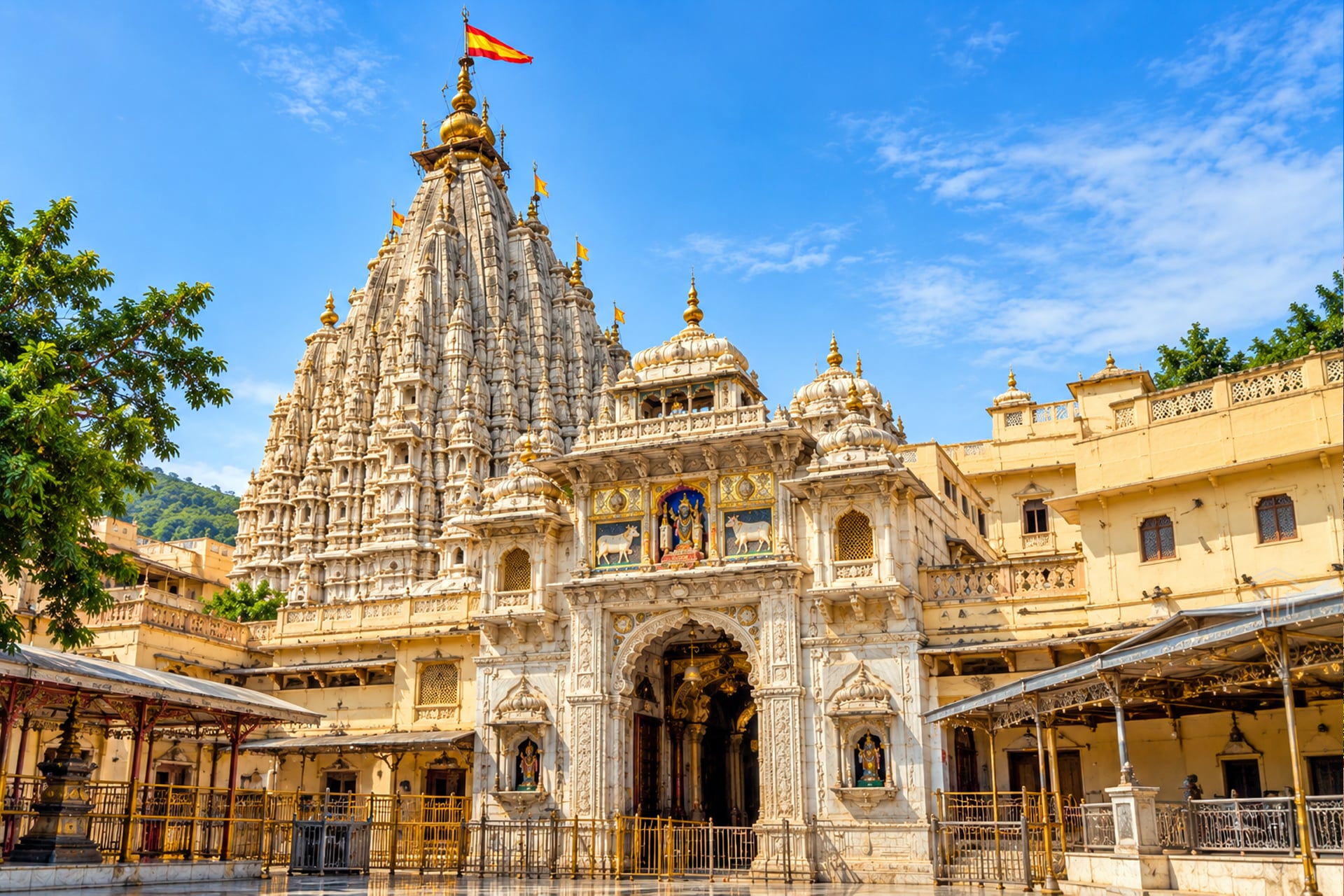
Shrinathji Temple at Nathdwara, Rajasthan, is the principal shrine of the Pushtimarg tradition, where Lord Krishna as Shrinathji, the seven-year-old child lifting Govardhan Hill, is lovingly served in a haveli as a living child through eight darshans a day.
- ReligionHindu
- DeityShrinathji (form of Krishna)
- TimingsMorning: 05:30 AM - 12:15 PM, Evening: 03:30 PM - 07: 30 PM
About the temple
About the temple
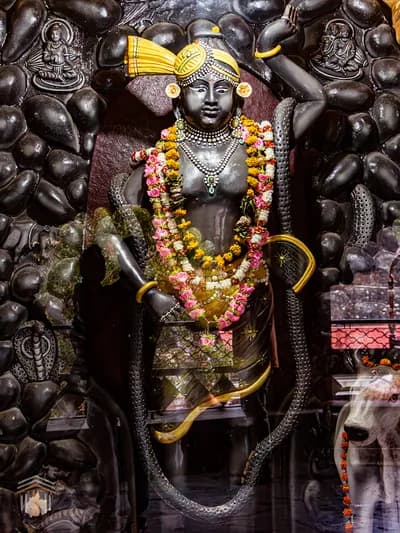
Shrinathji Temple stands in the town of Nathdwara on the banks of the Banas river in Rajsamand district, about 48 km north-east of Udaipur. It is the chief seat of the Pushtimarg, the path of grace founded by Shri Vallabhacharya, and one of the most visited Krishna shrines in India. The presiding deity, Shrinathji, is a self-manifested image of Krishna as a seven-year-old child, carved in relief in black stone, with his left arm raised to lift Govardhan Hill and his right hand resting on his waist. Tradition holds that the image emerged from Govardhan Hill in Braj, where Vallabhacharya began its worship. In the 17th century, to protect it from the destruction of temples in the Mathura region, the image was carried away from Braj, and after a long journey Maharana Raj Singh of Mewar offered it shelter. When the chariot’s wheel sank into the ground at the village of Sihad in 1672, the place was taken as the Lord’s chosen home, and the town that grew around it became Nathdwara, the Gateway to the Lord. The temple is a haveli, the household of the divine child, where Shrinathji is woken, bathed, dressed, fed, entertained and put to rest. Devotees receive eight short darshans a day, from Mangla at dawn to Shayan in the evening, each with its own dress, food and music. The shrine is managed by the Nathdwara Temple Board under the Nathdwara Temple Act of 1959, with the Tilkayat, the descendant of Vallabhacharya, as its spiritual head. Nathdwara is also famous for pichwai painting, Haveli Sangeet and its grand Annakut festival. Darshan is free.
Shrinathji Temple
Shrinathji Temple
The Sacred Legacy of Shrinathji Temple in Numbers
Discover the history, worship and scale of the principal shrine of the Pushtimarg tradition at Nathdwara.
- Year Shrinathji Was Installed at Nathdwara
- 1672
- Length of the Journey From Braj to Mewar
- About32 months
- Daily Darshans, From Mangla to Shayan
- 8
- Age of Krishna as Shrinathji
- 7
- Cows in the Temple Gaushala
- 500+
- Year of the Nathdwara Temple Act
- 1959
- Distance From Udaipur
- About48 km
Year Shrinathji Was Installed at Nathdwara
Length of the Journey From Braj to Mewar
Daily Darshans, From Mangla to Shayan
Age of Krishna as Shrinathji
Cows in the Temple Gaushala
Year of the Nathdwara Temple Act
Distance From Udaipur
Historical Background
The worship of Shrinathji began on Govardhan Hill in Braj, where, in Pushtimarg tradition, the image of Krishna lifting the hill emerged from the earth and was revealed to Shri Vallabhacharya in the late 15th century. Vallabhacharya’s son Shri Vitthalnathji (Gusainji) organised the elaborate daily seva and gave the deity the name Shrinathji. In 1669, when temples in the Mathura region were being destroyed, the priests carried the image away from Braj. After a journey of about 32 months, Maharana Raj Singh I of Mewar offered protection. When the chariot’s wheel sank at the village of Sihad on the Banas river, a haveli was built there, and Shrinathji was installed in 1672. In the early 19th century, when Nathdwara was threatened by raids, the deity was moved for safety to Udaipur and Ghasiyar before returning to Nathdwara. The temple was managed by the Tilkayats, the descendants of Vallabhacharya, until the Nathdwara Temple Act of 1959 created the Nathdwara Temple Board. The haveli fostered the pichwai tradition and Haveli Sangeet, and the Statue of Belief, opened in 2022, has made Nathdwara an even greater attraction.
About 1409 (VS 1466, traditional)
About 1409 (VS 1466, traditional)
The left arm of the Lord is seen rising from Govardhan Hill in Braj.About 1478-1479 (traditional)
About 1478-1479 (traditional)
The face of the Lord appears from the hill, and Shri Vallabhacharya is born.Late 15th century
Late 15th century
Vallabhacharya uncovers the image on Govardhan and begins its seva, founding the Pushtimarg tradition.16th century
16th century
Shri Vitthalnathji (Gusainji) organises the eight daily darshans and names the deity Shrinathji.1669
1669
The image is carried away from Govardhan to protect it from the destruction of temples in the Mathura region.1669-1672
1669-1672
The image journeys for about 32 months through Agra, Kota, Kishangarh and Jodhpur.1671-1672
1671-1672
Maharana Raj Singh I of Mewar gives shelter, the chariot’s wheel sinks at Sihad, and Shrinathji is installed in the new haveli.Early 19th century
Early 19th century
During raids on Nathdwara, the deity is moved for safety to Udaipur and Ghasiyar before returning.1959
1959
The Nathdwara Temple Act creates the Nathdwara Temple Board; the Supreme Court upholds it in 1963.29 October 2022
29 October 2022
The 369-foot Statue of Belief (Vishwas Swaroopam) of Lord Shiva is inaugurated in Nathdwara.10 November 2026
10 November 2026
Annakut (Govardhan Puja) is celebrated.


Synopsis
Shrinathji Temple at Nathdwara, near Udaipur, is the principal shrine of the Pushtimarg tradition of Shri Vallabhacharya. Its deity, Shrinathji, is Krishna as a seven-year-old child holding up Govardhan Hill, an image believed to have emerged from Govardhan in Braj. Carried away from Braj in the 17th century and given shelter by Maharana Raj Singh of Mewar, the image was installed at Sihad, now Nathdwara, in 1672, after the chariot's wheel sank into the ground there. The temple is run as a haveli, the household of the divine child, with eight short darshans a day whose timings change with the season. Managed by the Nathdwara Temple Board, the shrine is famous for its Annakut festival, its pichwai paintings and Haveli Sangeet. Darshan is free.
Shrinathji Temple stands at Nathdwara on the Banas river, Rajsamand district, Rajasthan, about 48 km north-east of Udaipur. It is the principal shrine of the Pushtimarg tradition, dedicated to Shrinathji, Krishna as a child lifting Govardhan Hill.
The image was worshipped on Govardhan in Braj from the time of Vallabhacharya. It was carried away from Braj in 1669 and installed at Sihad, now Nathdwara, in 1672 under the protection of Maharana Raj Singh I of Mewar.
The Maharanas of Mewar, who gave land and protection; the Tilkayats, descendants of Vallabhacharya, who lead the seva; and the devotees of Gujarat, Rajasthan, Maharashtra and across India.
The chief seat of the Pushtimarg (Shuddhadvaita) tradition, where Krishna is served as a living child through eight daily darshans, seasonal dress, food offerings, music and festivals.
Managed by the Nathdwara Temple Board under the Nathdwara Temple Act of 1959, upheld by the Supreme Court in 1963. The haveli is the home of the celebrated Nathdwara school of painting and the pichwai tradition.
Sacred significance
Principal Seat of Pushtimarg
Nathdwara is the chief shrine of the Pushtimarg, the path of grace founded by Shri Vallabhacharya, and the most important pilgrimage for its followers. Every Pushtimarg household looks to Shrinathji as its Lord.
Krishna Lifting Govardhan
Shrinathji is Krishna as a child of seven holding up Govardhan Hill, the protector who sheltered Braj from Indra's storm. Devotees pray to him for protection in the storms of life.
A Self-Manifested Image
The image is believed to have emerged on its own from Govardhan Hill, making Shrinathji a swaroop of the Lord himself rather than a made image.
The Lord as a Living Child
In the haveli, Shrinathji is woken, bathed, dressed, fed, entertained and put to rest like a beloved child, as Yashoda cared for Krishna in Gokul.
Eight Daily Darshans
Mangla, Shringar, Gwal, Rajbhog, Uthapan, Bhog, Aarti and Shayan follow the child's day, and each darshan is a short glimpse of the Lord at that moment of his life.
The Path of Grace
Pushtimarg teaches that liberation comes through the grace (pushti) of Krishna and loving seva, not through renunciation or austerity.
Seva With Beauty
Music, painting, cooking, clothing and flowers are all offered as seva, so that every art becomes a form of worship.
Annakut
After Diwali, a mountain of food is offered to Shrinathji to recall the worship of Govardhan, one of the temple's main festivals. In 2026 it falls on 10 November.
Janmashtami and Nand Mahotsav
Krishna's birth is celebrated at midnight, and the next day the joy of Nand Baba is shared with devotees in the Nand Mahotsav.
Navneet Priyaji
The child Krishna holding butter, worshipped in his own shrine within the haveli, is especially dear to Pushtimarg devotees.
Seven Flags and the Sudarshan Chakra
The seven flags flying over the haveli and the Sudarshan Chakra on its pinnacle are honoured by devotees.
Architecture
Shrinathji Temple is built as a haveli, a large mansion in the style of Mewar, rather than as a temple with a towering shikhara, because it is the home of the divine child. Behind its gateways lies a series of courtyards, verandahs and halls arranged around the private inner chamber where Shrinathji resides. The image itself is carved in relief on a slab of black stone, showing the child Krishna with his left arm raised to hold Govardhan, adorned with jewels, including a diamond at his chin, and dressed in silk and zari clothing that changes for every darshan. Behind him hangs a pichwai, a painted cloth that changes with the season and festival. Devotees take darshan from a hall in front of the sanctum. The haveli includes many rooms for the household of the Lord: the kitchens (rasoighar) where bhog is prepared, and stores for milk (doodhghar), betel (paanghar), sugar (mishrighar), sweets (pedaghar), flowers (phoolghar) and jewellery (gahnaghar), a treasury (kharcha bhandar), a stable (ashvashala) and a baithak. A grinding wheel of gold and silver (chakki) is also part of the haveli. The haveli is crowned by a kalash with the Sudarshan Chakra and seven flags. Separate shrines in the complex house Navneet Priyaji and other forms of Krishna. The surrounding lanes of the old town lead to the haveli, lined with shops of prasad, flowers and pichwais.
Haveli
The Haveli of the Lord
The temple is a mansion in Mewar style, designed as a home for the child Krishna rather than a towering temple. Its plan follows the life of a royal household.
Deity
The Black Stone Image
Shrinathji is carved in relief on black stone, with his left arm raised. He is dressed and adorned afresh for each darshan.
Pichwai
Painted Backdrops
Painted cloth hangings behind the deity change with the season and festival. They are the origin of Nathdwara's pichwai art.
Kitchens
The Rasoighar
Large kitchens prepare the bhog for the eight darshans and the festivals.
Stores
Household Stores
Rooms for milk, betel, sugar, sweets, flowers and jewellery serve the seva.
Pinnacle
Sudarshan Chakra and Seven Flags
The haveli is crowned by a kalash with the Sudarshan Chakra and seven flags.
Shrines
Shrine of Navneet Priyaji
A separate shrine within the complex for the child Krishna holding butter. It has its own darshans.
Interesting facts

Shrinathji's temple is called a haveli, a household, because the Lord is served as a living child. There is no tall shikhara as in most North Indian temples. Devotees speak of going to Shriji's home, not to a temple.
Deities & Shrines
Shrinathji
The presiding deity, Krishna as a seven-year-old child holding up Govardhan Hill with his left arm. He is served through eight darshans a day. Devotees lovingly call him Shriji Bawa.
Shri Navneet Priyaji
The child Krishna holding a ball of butter, worshipped in his own shrine within the haveli.
Shri Madan Mohanji
A form of Krishna served within the Nathdwara tradition and honoured by devotees as part of the Lord's household.
Shri Vitthalnathji Temple
A separate haveli in Nathdwara town for Vitthalnathji, a form of Krishna linked to Gusainji's lineage. It is visited by pilgrims along with the main haveli.
Shri Mahaprabhuji (Vallabhacharya)
The founder of Pushtimarg. Devotees pay respects to him as the guru who revealed Shrinathji's seva.
Giriraj Govardhan
Govardhan Hill, from which Shrinathji emerged, is worshipped as Giriraj, and a Giriraj parikrama is honoured in Nathdwara.
Sudarshan Chakra
Krishna's discus on the haveli's pinnacle, with seven flags, is honoured as the Lord's protecting weapon.
Shrinathji's Cows
The cows of the temple gaushala are cherished as the Lord's own herd. Devotees offer seva for their care.
Darshan & Service Offerings
| Service | Timing | Price | Notes |
|---|---|---|---|
| General Darshan (Free Darshan) | During the eight daily darshans. | Free | Darshan of Shrinathji is free for everyone during each darshan opening. Crowds are largest at Rajbhog and on festivals and weekends. |
| Mangla Darshan | About 5:30-6:30 AM. | Free | Join the first darshan of the day. |
| Shringar Darshan | About 7:30-8:00 AM. | Free | See the Lord in his full adornment for the day. |
| Gwal Darshan | About 9:15-9:30 AM. | Free | See Shrinathji as the cowherd, a short and joyful darshan. |
| Rajbhog Darshan | About 11:00 AM-12:00 PM. | Free | The most elaborate darshan of the day, with the Lord in royal dress. Allow time for the queue. |
| Evening Darshans | About 3:45-7:45 PM. | Free | Uthapan, Bhog, Aarti and Shayan darshans in the afternoon and evening. Shayan is open only for part of the year. |
| Navneet Priyaji Darshan | As per the shrine's schedule. | Free | Take darshan of the child Krishna with butter in his own shrine within the haveli. |
| Shriji Darshan Yojana / Shriji Card | Subject to booking. | As per Temple Board rules | A Temple Board scheme for special darshan access. Book on the Temple Board's website. |
| Manorath | Booked in advance. | As per Temple Board rates | Sponsor a special offering of food, dress or decoration for Shrinathji. Requests are made through the Temple Board. |
| Seva Bhent | Temple office hours or online. | Donation-based | Offer a gift for Shrinathji's seva. |
| Niyat Samagri Nyochhavar | Temple office hours or online. | As per Temple Board rates | Sponsor the regular materials used in the daily seva. |
| Gaumata Seva | Temple office hours or online. | Donation-based | Contribute to the care of Shrinathji's cows in the gaushala. |
| Cottage Booking | Online and at the reception. | As per Temple Board tariff | Book Temple Board cottages and guest houses close to the haveli. |
| Prasad Purchase | During counter hours. | As per counter rates | Buy Shrinathji's prasad and other sweets at the Temple Board counters. |
Visitor information
Location
Shrinathji Temple, Nathdwara, Rajsamand district, Rajasthan - 313301, India, about 48 km north-east of Udaipur.
Darshan Hours
Eight short darshans between about 5:30 AM and 7:45 PM. The haveli is closed between darshans.
Entry
There is no entry fee. Darshan is free.
Check the Day's Timings
Darshan times change daily with the season and festivals. Check the Temple Board's daily schedule before you set out.
Mobile Phones and Cameras
Mobile phones, cameras and photography are not allowed inside the haveli. Leave them at your hotel or at the deposit counters.
Footwear
Leave footwear at the shoe stands outside the haveli.
Time Needed
Many pilgrims stay a day or two to see several darshans.
Crowd Levels
Rajbhog is among the busiest darshans. Weekends, Janmashtami, Diwali, Annakut and Holi draw huge crowds.
Separate Queues
Men and women often queue separately, and the crowd surges forward when the doors open. Take care of children and the elderly.
Online Services
The Temple Board offers online darshan booking (Shriji Card), seva booking and cottage reservations.
Accessibility
The old-town lanes and the darshan crowd can be difficult for elderly and disabled visitors. Ask the Temple Board staff for help.
Language
Hindi and Mewari are widely spoken.
Important Visitor Notice
Follow the instructions of the Temple Board staff and police, especially at festivals. Beware of touts offering paid darshan.
Location
Rajsamand, Rajasthan, India
Best Time to Visit
October to March
Cool, pleasant weather makes these months the best time to visit Nathdwara and Udaipur. December and January nights are cold. Carry warm clothes.
Diwali and Annakut (October-November)
One of the haveli's main festivals, with Annakut on 10 November 2026. Expect very large crowds.
Janmashtami (August-September)
Krishna's birth is celebrated at midnight, followed by the joyful Nand Mahotsav.
Holi (February-March)
Colours and the Dolotsav fill the haveli and the town.
Sharad Purnima (October)
A beautiful autumn full moon, celebrated with special seva.
Rajbhog
The most popular darshan of the day. Arrive early to find a place in the queue.
Summer (April-June)
Rajasthan is very hot, and temperatures can reach 40 degrees Celsius or more. Visit early in the morning and rest in the afternoon.
Monsoon (July-September)
Rain brings green hills, and the Hindola swing festival is celebrated in the haveli.
Nearby places
Statue of Belief (Vishwas Swaroopam)
About 1-2 km
- A 369-foot statue of Lord Shiva seated on Ganesh Tekri, opened in 2022, among the tallest statues in the world. Lifts take visitors to viewing galleries.
Festivals & culture
Shrinathji's haveli follows the Pushtimarg calendar, with festivals almost every week in which the Lord's dress, pichwai, music and food change with the season and the occasion. Major festivals include Annakut, Janmashtami, Diwali, Holi and Sharad Purnima. The haveli is decorated with lights and flowers, and large crowds of devotees visit during the major festivals. Festival dates follow the Hindu calendar and change every year.
Annakut (Govardhan Puja)
October-November (10 November 2026)
A mountain of rice and many other dishes is offered to Shrinathji, recalling the worship of Govardhan. After darshan, the rice prasad is carried away by tribal devotees in a famous custom.
Diwali
October-November (8 November 2026)
The haveli is lit with lamps, and the cows are honoured. Diwali leads into Annakut, which in 2026 falls two days later.
Janmashtami and Nand Mahotsav
August-September
Krishna's birth is celebrated at midnight with special darshan, and the next day devotees share the joy of Nand Baba with songs and sprinkling of curd and turmeric.
Holi and Dolotsav
February-March
Colours and the Dolotsav swing festival fill the haveli in a celebration that begins weeks before Holi.
Additional information
Shrinathji Temple
Also known as Shrinathji Ki Haveli and Nathdwara Temple. Nathdwara means 'Gateway to the Lord'.
Location
Nathdwara, Rajsamand district, Rajasthan - 313301, India.
Darshan Hours
Eight darshans between about 5:30 AM and 7:45 PM, changing daily with the season and seva.
Nathdwara Temple Board
Manages the temple under the Nathdwara Temple Act of 1959. The Tilkayat is the spiritual head of the seva.
Pushtimarg
The path of grace founded by Shri Vallabhacharya, based on the Shuddhadvaita philosophy.
Entry Fee
Entry and darshan are free.
Online Services
Darshan booking (Shriji Card), sevas, cottages and donations through the Temple Board's website.
Photography
Phones, cameras and photography are not allowed inside the haveli.
Dress Code
Modest, traditional clothing is expected.
Nathdwara School of Painting
The haveli fostered the famous pichwai and Nathdwara painting traditions.
Crowd Advisory
Expect very large crowds at Rajbhog, weekends and festivals. Arrive early.
Temple facilities
Temple Board Cottages
The Temple Board runs cottages and guest houses including New Cottage, Vallabh Vilas, Chitalwala Vishranti Gruh, Agrawal Cottage and Balasinore Sadan.
Online Reservations
Cottages, darshan passes and sevas can be booked on the Temple Board's website. Use only the Temple Board's own website for bookings.
Town Hospital
The Temple Board runs a town hospital in Nathdwara among its social services.
Phone and Luggage Deposit
Deposit counters near the haveli keep phones and bags, which are not allowed inside. Keep your token safely and collect your items before the counters close.
Shoe Stands
Shoe stands near the haveli entrances keep footwear safe.
Prasad Counters
Temple Board counters sell Shrinathji's prasad and sweets. Check the date of packing on boxed prasad.
Education and Community Facilities
The Temple Board also runs educational institutions, an auditorium and other community facilities. These reflect the haveli's long role in the life of the town.
Shrinath Gaushala
The temple's cow shelter, where devotees can offer seva.
Emergency services
India Emergency Response
Not location-specific
Contact
112
- Call 112 for urgent police, medical or fire assistance through India's integrated emergency response system.
Top picks
Nathdwara Pedas
The peda of Nathdwara's markets is the town's best-known sweet, and many pilgrims carry it home as prasad. Popular shops include Jodhpuri Mishthan Bhandar and Shri Ji Dairy.
Rabri
Thick, creamy rabri, a favourite at Vallabh Dairy, where the recipe changes with the season.
Visitor guide
Maharana Pratap Airport, Udaipur (Dabok)
About 55-60 km
- The nearest airport, with flights from Delhi, Mumbai and other cities. Taxis take about an hour and a quarter.
Gallery
Videos
Third-party videos may include ads or external commentary.
Frequently Asked Questions
Lord Krishna as a seven-year-old child lifting Govardhan Hill, the principal deity of the Pushtimarg tradition.
In Nathdwara, Rajsamand district, Rajasthan, about 48 km north of Udaipur.
In 1672, after the image left Braj in 1669.
Because Shrinathji is served as a living child in his own household.
Mangla, Shringar, Gwal, Rajbhog, Uthapan, Bhog, Aarti and Shayan.
No, they change daily with the season, seva and festivals.
Yes.
Yes, through the Shriji Card / Shriji Darshan Yojana on the Temple Board's website.
No, phones, cameras and photography are not allowed.
Thor, along with mohanthal and other sweets.
The Nathdwara Temple Board, under the Nathdwara Temple Act of 1959.
Annakut, the day after Diwali; 9 November in 2026.
Pichwai painting.
Maharana Pratap Airport, Udaipur, about 55-60 km away.