
26°C
Puri
Shree Jagannath Temple
 Puri, Odisha, India
Shree Jagannath Temple in Puri, Odisha, is a sacred Char Dham shrine dedicated to Jagannath, Balabhadra and Subhadra, renowned for its wooden deities, annual Rath Yatra and Odia heritage.
- ReligionHindu
- DeityLord Jagannath (a form of Lord Vishnu),
Balabhadra,
and Subhadra - Timings5:30 AM to 9:00 PM daily
About the temple
About the temple
Shree Jagannath Temple in Puri, Odisha, is one of India's most sacred pilgrimage sites and the eastern Dham of the Char Dham circuit. Built in the 12th century by Anantavarman Chodaganga Deva of the Eastern Ganga dynasty, it is dedicated to Lord Jagannath, a form of Vishnu/Krishna. The temple is renowned for its Kalinga-style architecture, its wooden deities that are ceremonially replaced every 12 or 19 years (Nabakalebara), its ancient daily rituals, and the annual Rath Yatra, which draws millions of devotees.
Shree Jagannath Temple
Shree Jagannath Temple
The Majestic Numbers of Shree Jagannath Temple
Shree Jagannath Temple in Puri is a 12th-century pilgrimage site whose monumental Kalinga architecture, elaborate daily rituals and world-famous Rath Yatra have made it a lasting symbol of spiritual unity and cultural richness.
- Construction begun by King Anantavarman Chodaganga Deva and completed in the 13th century under Anangabhima Deva III
- 12th Century CE
- Height of the temple's curvilinear main tower
- 65 m (214 ft)
- Principal deities (Jagannath, Balabhadra and Subhadra), worshipped with Sudarshana and other deities in the sanctum
- 3
- Gates: Singhadwara (east), Ashwadwara (south), Vyaghradwara (west) and Hathidwara (north)
- 4
- Chariots built anew each year for the Rath Yatra, with 16, 14 and 12 wheels
- 3
- Steps of the Baisi Pahacha leading from the Singhadwara into the temple complex
- 22
- Rice reportedly cooked daily for Mahaprasad; reports range from about 50-60 quintals to about 300 quintals, so treat as an estimate
- About5-30 tonnes
- Earthen pots commonly stacked on each hearth, with the top pot reported to cook first
- 7 (up to 9)
- Height of the Meghanada Pacheri outer wall, reported at up to 24 ft in places
- 20 ft (6.1 m)
Construction begun by King Anantavarman Chodaganga Deva and completed in the 13th century under Anangabhima Deva III
Height of the temple's curvilinear main tower
Principal deities (Jagannath, Balabhadra and Subhadra), worshipped with Sudarshana and other deities in the sanctum
Gates: Singhadwara (east), Ashwadwara (south), Vyaghradwara (west) and Hathidwara (north)
Chariots built anew each year for the Rath Yatra, with 16, 14 and 12 wheels
Steps of the Baisi Pahacha leading from the Singhadwara into the temple complex
Rice reportedly cooked daily for Mahaprasad; reports range from about 50-60 quintals to about 300 quintals, so treat as an estimate
Earthen pots commonly stacked on each hearth, with the top pot reported to cook first
Height of the Meghanada Pacheri outer wall, reported at up to 24 ft in places
Historical Background
Shree Jagannath Temple in Puri, Odisha, is one of India’s most revered Vaishnavite pilgrimage sites, dedicated to Lord Jagannath, a form of Lord Krishna. Rebuilt in the 12th century under the Eastern Ganga dynasty, the temple became a major centre of devotion and royal patronage over the centuries. Its spiritual traditions were further enriched by the presence of Chaitanya Mahaprabhu and the growth of Vaishnava devotion. Despite periods of invasion and changing administration, the temple has preserved its ancient rituals and remains especially renowned for the grand annual Rath Yatra, drawing millions of devotees to Puri.
12th century CE
12th century CE
The temple is rebuilt on the site of an earlier shrine by Anantavarman Chodaganga Deva of the Eastern Ganga dynasty (reigned c. 1078-1148 CE).c. 1198 CE
c. 1198 CE
The present structure is completed and consecrated under King Anangabhima Deva, after some 14 years of work, according to traditional accounts.13th century
13th century
Anangabhima Deva III (r. c. 1211-1238) dedicates the kingdom of Utkala to Jagannath and rules as the deity's servant.15th-16th centuries
15th-16th centuries
The Gajapati kings, such as Kapilendra Deva, make the temple a major state-supported religious centre. Chaitanya Mahaprabhu lives in Puri, deepening its importance for Vaishnava devotion.1568 CE
1568 CE
After defeating Mukunda Deva, the last independent Hindu king of Odisha, General Kalapahad, of the Bengal Sultan's army, attacks and plunders the temple. Accounts differ on how much of the deities was destroyed or saved.1575 CE
1575 CE
The deities are reinstalled in Puri under Ramachandra Deva I of Khurda, who becomes the temple's hereditary superintendent.1751 CE
1751 CE
The Marathas become de facto rulers of Odisha under a treaty between Alivardi Khan and Raghuji Bhonsle.1803-1809 CE
1803-1809 CE
The East India Company takes over the temple's management in 1803. It is later run by a body of local Pundits, and in 1809 it is returned to the Raja of Khurda.1954-1955
1954-1955
The Shree Jagannatha Temple Act, passed in 1954 as Orissa Act 11 of 1955, becomes law in November 1955 and forms the basis of the current administration under a Managing Committee.Present day
Present day
The temple remains a major pilgrimage destination, especially during Rath Yatra, and continues its centuries-old rituals.


Synopsis
Shree Jagannath Temple in Puri, Odisha, is an iconic Hindu pilgrimage site and one of the four Char Dham sites. It is dedicated to Lord Jagannath, a form of Vishnu/Krishna, who is worshipped alongside his siblings Balabhadra and Subhadra. Built in the 12th century by the Eastern Ganga dynasty, the temple is celebrated for its magnificent Kalinga-style architecture, its ancient rituals, including the ceremonial renewal of its wooden deities, and the world-famous Rath Yatra festival. It draws pilgrims in vast numbers throughout the year, and especially during Rath Yatra.
Shree Jagannath Temple in Puri, Odisha, is dedicated to Jagannath, regarded as a form of Vishnu (Krishna), together with Balabhadra and Subhadra. According to tradition recorded in the Puranas and the temple chronicle, King Indradyumna was guided by Vishnu to the Puri seashore, where a radiant log floated in. A divine carpenter, Vishwakarma or in some tellings Vishnu himself, agreed to carve the deities on condition that he was left undisturbed. After about two weeks, hearing no sound, the anxious queen persuaded the king to open the door. The carpenter disappeared, leaving the images unfinished and without hands. A divine voice told the king to install them as they were, and devotees have revered them in this form ever since.
Puri was a sacred site long before the present temple. The current structure was begun by Anantavarman Chodaganga Deva (r. c. 1078-1150) of the Eastern Ganga dynasty, after he conquered Utkala in 1112. It was completed under Anangabhima Deva III (r. 1211-1238), for whom the temple administration gives 1230, though other sources give earlier dates. Anangabhima III dedicated the kingdom to Jagannath and styled himself the deity's "Rauta" (servant). The temple is a landmark of Kalinga architecture, with a spire about 65 metres high crowned by the Nila Chakra.
The Gajapati kings, such as Kapilendra Deva, made the temple a major state-supported religious centre. Vaishnava teachers including Ramanuja, Madhva and Vallabha are associated with Puri, and Shankaracharya founded the Govardhan Math there. Chaitanya Mahaprabhu settled in Puri around 1510 and lived there until his death in 1534, which made it central to Gaudiya Vaishnavism. The Rath Yatra is far older than his time. It is traditionally dated to the Ganga period and was described by a European traveller in the early 14th century. Its Chhera Pahara ritual, in which the Gajapati king sweeps the chariot road, expresses equality before Jagannath.
In 1568, after defeating Mukunda Deva, the Afghan general Kalapahad of the Bengal Sultanate attacked Puri. Temple chronicles record that the images were destroyed, while servitors preserved their sacred core. Ramachandra Deva I of Khurda restored worship, and new images were installed in 1575. The Madala Panji records that the temple was attacked 18 times over the centuries, and servitors often moved the deities to safety.
The Marathas took control of Odisha in 1751 and kept the temple's management in their own hands. They patronised its worship and encouraged repairs and pilgrimage, but also levied a pilgrim tax as a source of revenue.
After 1803 the East India Company took over the temple's administration. Regulation IV of 1806 placed it under a board of government-appointed Brahmins, and in 1809 hereditary supervision under the Raja of Khurda was restored. The pilgrim tax continued until Act 10 of 1840, after missionary criticism in Britain led to the end of state involvement in religious management. The temple then remained under indigenous management for the rest of the colonial period.
The Puri Shri Jagannath Temple (Administration) Act, 1952 documented servitors' rights and customs. The Shri Jagannath Temple Act, 1955 then set up the Managing Committee, with the Gajapati Maharaja of Puri as Chairman. Its main provisions took effect in 1960, and the Act was amended in 1983 and again in 2004.
Today the temple draws millions of pilgrims, and the Rath Yatra is followed by devotees worldwide. Recent milestones include the inauguration of the Shree Mandir Parikrama heritage corridor on 17 January 2024 and the reopening of the Ratna Bhandar treasury in July 2024 for inventory and repair.
Sacred significance
Divine Manifestation of Lord Jagannath
Shree Jagannath Temple in Puri is one of the four Char Dham pilgrimage sites and is dedicated to Lord Jagannath, regarded as a form of Vishnu (Krishna), together with his siblings Balabhadra and Subhadra. Devotees regard the deities as living presences, and the daily rituals mirror a human day: waking, bathing, dressing, meals and rest. Worship here is syncretic, with Vaishnava, Shaiva, Buddhist, Jain and tribal elements. Tradition holds that darshan of Jagannath and partaking of his Mahaprasad bring liberation (moksha). Entry to the temple is restricted to Hindus, as a sign at the Lion Gate states, though the rule has been debated for decades.
Rituals and Devotional Practices
The daily nitis begin with Dwaraphita (opening of the sanctum) and Mangala Alati around 5:30 am. Sakala Dhupa (Raj Bhoga), the main morning food offering, follows between 9 and 10 am. Sandhya Alati, the evening lamp offering, is around 6 pm, followed by Sandhya Dhupa. In Nabakalebara, the five worshipped wooden images are replaced at intervals of 8, 11, 12 or 19 years, timed by the lunar calendar when the month of Ashadha repeats. The last was in 2015, and the old images are buried at Koili Baikuntha. Each Ashadha, the Rath Yatra takes the deities in newly built wooden chariots to the Gundicha Temple, about 3 km away.
Architecture
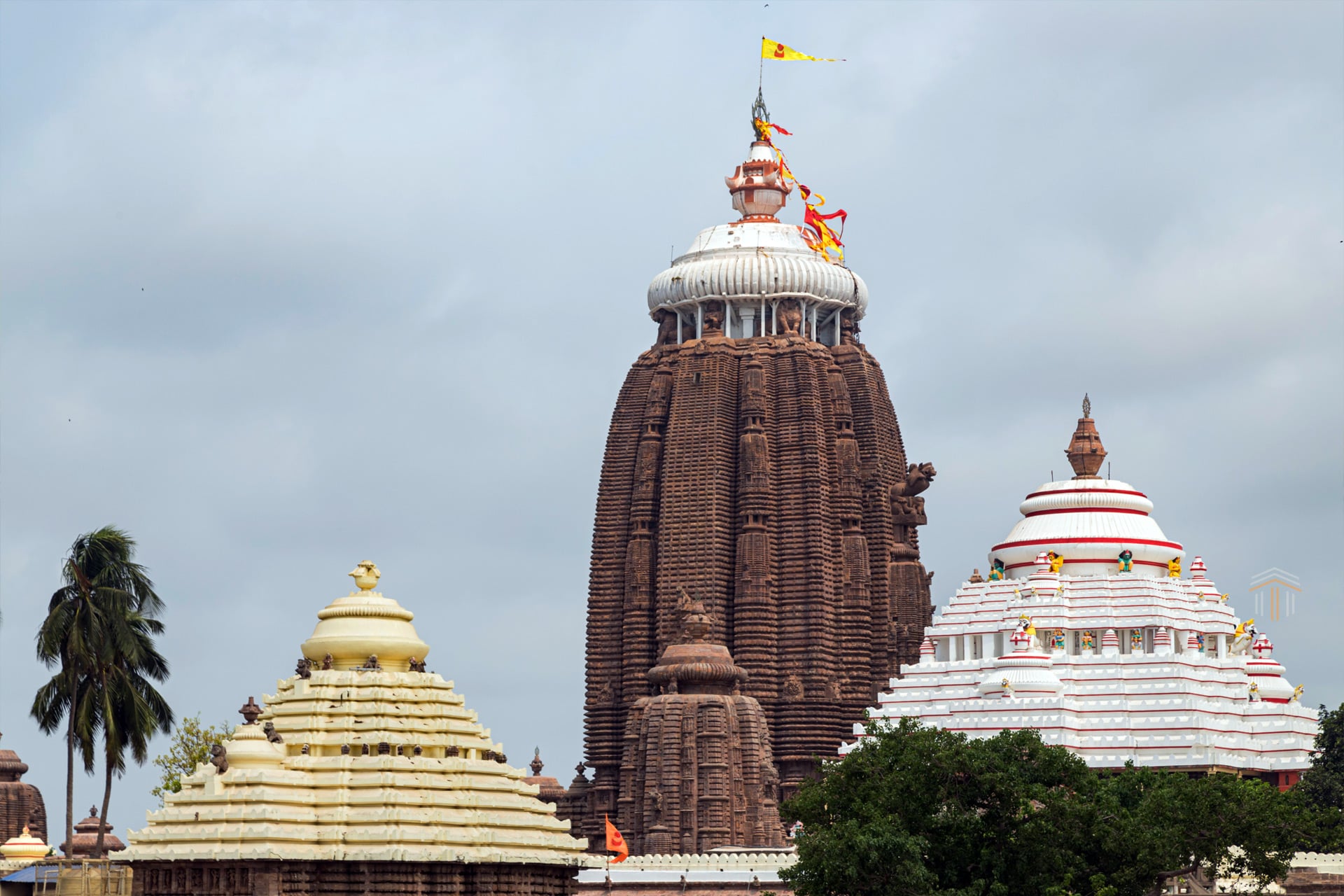
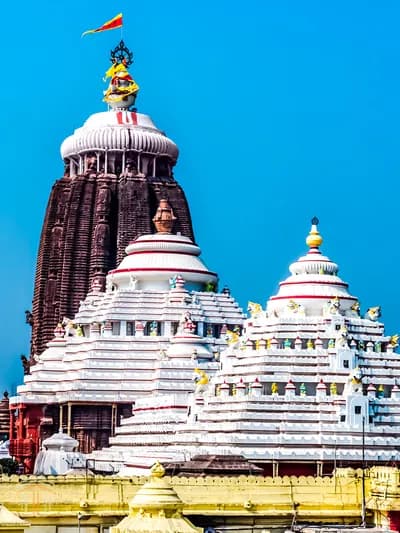
The Shree Jagannath Temple in Puri showcases the distinctive Kalinga style of temple architecture, characterized by its towering rekha deula (vimana), intricately carved stonework, and monumental gateways. The temple complex features the Jagamohana (assembly hall), Nata Mandapa (dancing hall), and Bhoga Mandapa (offering hall), arranged along the main axis. Its imposing Neelachakra (Blue Wheel) crowns the sanctum, while the surrounding walls, subsidiary shrines, and sculptural details reflect Odisha’s rich religious and architectural heritage.
Shikhara
The Towering Spire of Jagannath
The temple's curvilinear main tower (a Rekha Deula) rises about 65 metres (214 ft) and dominates the surrounding landscape. It is crowned by the Nila Chakra, an eight-spoked wheel of eight metals, which is distinct from the Sudarshana worshipped inside the sanctum. A different flag is hoisted on the Nila Chakra each day. The tower is a landmark of Kalinga architecture, noted for its sculptural richness.
Singhadwara (Lion's Gate)
The Main Entrance
The Singhadwara is the temple's principal, east-facing entrance, flanked by two large crouching lions and the guardian figures Jaya and Vijaya. Patita Pavana, a form of Jagannath, is painted beside the entrance, and the monolithic Aruna Stambha stands in front. The gate opens onto the Baisi Pahacha, a flight of 22 steps. During the Rath Yatra, the deities pass through this gate in the Pahandi procession, which begins at the Ratnasinghasana in the sanctum and ends at the chariots on the Bada Danda.
Mandapa
Mukti Mandapa: The Platform of Liberation
The Mukti Mandapa is a raised granite platform with a pillared roof, south of the main temple. It is the seat of a council of learned Brahmin pandits from designated villages, chaired by the Shankaracharya of Puri. The council is regarded as the highest authority on religious questions, settles disputes among servitors and approves the annual almanac. Its pillars carry painted decoration.
Natya Mandapa
The Dancing Hall
The Natamandapa (Nata Mandir) is the dancing hall between the Jagamohana and the Bhogamandapa, added after the main tower. It was historically where Mahari devadasis performed for the deity, a tradition that gave rise to Odissi, though Mahari dance is no longer performed in the temple. Today devotees gather here to view the deities.
Bhog Mandapa
The Hall of Offerings
The Bhogamandapa is the offering hall at the far end of the temple's four-part sequence, about 61 metres from the Ratnabedi. Food offerings for pilgrims, known as Chhatra Bhog, are made here. Tradition attributes the practice to Adi Shankaracharya, who introduced it so pilgrims could share the temple's food. Most of the deities' daily offerings are made in the sanctum near the Ratnasinghasana.
Kitchen
The Grand Kitchen of Jagannath
The Rosha Ghara is often called the world's largest temple kitchen, though some sources say second largest. Mahaprasad is cooked by hereditary cooks (Suaras) in earthen pots stacked over wood-fired earthen hearths. It is strictly vegetarian, with no onion or garlic. Published figures vary widely, from roughly 400 to 600 cooks with hundreds of assistants and from about 240 to 750 hearths, so the numbers are best treated as estimates.
Patitapabana Bana
The Temple Flag
The flag atop the spire, the Patitapabana Bana, is hoisted on the Nila Chakra and is changed every evening by hereditary Chunara (Chola) Garuda servitors, who climb the tower without a harness. It is regarded as equivalent to the deities' image in the sanctum. That it flies against the wind is a widely repeated belief, not something documented in the temple's records.
Boundary Wall
Meghanada Pacheri: The Outer Wall
The Meghanada Pacheri is the outer stone wall of the temple complex, 20 to 24 feet high and about 6 feet thick, with serrated battlement designs along its top. It has four gates, the Singhadwara (east), Ashwadwara (south), Vyaghradwara (west) and Hathidwara (north), named for their guardian animal sculptures, with navagraha reliefs on the gate architraves. A second wall, the Kurma Bedha, encloses the main temple.
Ananda Bazaar
The Holy Food Market
Ananda Bazaar, in the north-east corner of the outer enclosure, is where Mahaprasad is sold to devotees. It is described as the biggest open-air eatery in the world, and pilgrims eat here together regardless of caste, creed or status.
Koili Baikuntha
The Burial Ground of the Deities
Koili Baikuntha is an enclosed area in the north-western part of the temple premises, between the outer and inner walls. During Nabakalebara the old wooden deities are buried here in a rite called Patali. It represents the cycle of death and renewal of the deities' bodies.
Garbha Griha (Sanctum Sanctorum)
The Inner Sanctum
The Garbha Griha, in the vimana beneath the main tower, houses the wooden images of Jagannath, Balabhadra and Subhadra on the Ratnabedi (jewelled platform), together with Sudarshana, Madanmohan, Sridevi and Vishwadhatri. The deities are dressed and adorned according to the season.
Interesting facts

The Patitapabana Bana, hoisted on the Nila Chakra atop the spire, is widely said to fly against the wind. This is a popular belief; the temple's own records do not make the claim. It may reflect turbulence around the tower, which puts the flag high above and behind the massive stone spire, where the airflow often differs from the breeze at street level. What is documented is the daily change of the flag by hereditary Chunara servitors, who climb the tower without a harness.
Deities & Shrines
Lord Balabhadra
Lord Balabhadra is the elder brother of Jagannath, identified with Balarama and with the serpent Ananta. In the Puri temple his wooden image is white-faced, with oval eyes, stump-like arms and a snake-hood on his head. It stands on the viewer's left on the Ratnavedi, beside Subhadra and Jagannath. The plough, his traditional emblem, is added to the image during the Suna Besha, when gold ornaments including a plough and a mace are placed on him. Devotees revere him as a symbol of strength and protective brotherly love.
Goddess Subhadra
Subhadra is the younger sister of Jagannath and Balabhadra. Her wooden image is yellow, about five feet tall, with oval eyes and no arms. She stands between her two brothers on the Ratnavedi. Tradition regards her as Shakti or Prakriti, and one Puranic account identifies her as a birth of Lakshmi. Her presence between the brothers is read by devotees as a symbol of family unity and love.
Sudarshana
Sudarshana, Vishnu's divine discus, is worshipped in Puri as a red, post-like wooden image beside Jagannath. He is replaced in the Nabakalebara and, in the Rath Yatra Pahandi, is carried out first and taken to Subhadra's chariot. He should not be confused with the Nila Chakra on the spire, a distinct emblem, though tradition also links the two. Devotees regard Sudarshana as a symbol of protection and righteousness.
Goddess Mahalaxmi
The Lakshmi Temple in the complex is dedicated to Mahalaxmi, the consort of Jagannath, who plays an important role in the temple's rituals. Tradition holds that she oversees the temple kitchen. During the Rath Yatra she is left behind at the main temple. On Hera Panchami she visits the Gundicha Temple in anger, and at Niladri Bije Jagannath must offer her rasagulla before she allows him to re-enter the temple.
Goddess Bimala
The Vimala (Bimala) Temple, in the south-west corner of the inner enclosure near the sacred Rohini Kunda, is generally regarded as a Shakta pitha. She is worshipped as a form of Parvati or Durga and, in Puri's tradition, as the tantric consort of Jagannath and a guardian of the temple. Devotees traditionally pay respects to her before worshipping Jagannath. Food offered to Jagannath is re-offered to Bimala, a practice known as Bimala Prasad, before it is deemed Mahaprasad.
Lord Narasimha
The complex includes shrines to Lord Narasimha, the fierce man-lion avatar of Vishnu who protects his devotees. The Adi Nrusingha temple stands in front of the Mukti Mandapa. In the legend of Indradyumna, Narasimha appears from the king's sacrifice and instructs how Narayana should be manifested.
Lord Hanuman (Bedi Hanuman)
Bedi Hanuman, also called Daria Mahavir, is a small seaside temple on Chakratirtha Road in Puri, about 3 km from the Jagannath temple. It lies outside the temple complex, though the complex has its own Hanuman shrine. According to the local legend, Jagannath had appointed Hanuman to protect Puri from the sea. When Hanuman left for Ayodhya without telling him, sea water entered the city and damaged the temple, so Jagannath had him bound with rope or chains and ordered him to stay vigilant day and night. Devotees believe the sea has not entered the city since.
Goddess Saraswati
A shrine dedicated to Goddess Saraswati, the goddess of wisdom and learning, stands among the smaller shrines within the temple complex.
Darshan & Service Offerings
| Service | Timing | Price | Notes |
|---|---|---|---|
| Free General Darshan | The temple is open from about 5:00 AM to 10:30 PM, with darshan paused during certain offerings; exact windows vary | Free | Darshan is free for Hindu devotees through the Singhadwara. No ticket or booking is required, and the temple administration says it does not charge for darshan. Queues are longest on weekends, holidays and festival days. Confirm current darshan windows with the temple administration, since sources differ on afternoon breaks. |
| Sahanamela | About 7:00-8:00 AM | Free | A public darshan period in the morning, not a ritual. It is a quieter time for darshan on many days. |
| Mangala Alati and Sandhya Alati | About 5:30 AM and about 6:00 PM | Free | Mangala Alati, the first lamp offering of the day, follows the opening of the sanctum doors, with kirtan sung by the Badachhata Matha. Sandhya Alati at about 6:00 PM begins the evening rituals and is followed by Sandhya Dhupa. Neither is ticketed. |
| Chandana Lagi | After Sandhya Dhupa, about 8:00 PM | No official sponsorship price found | After the evening meal offering, the deities are anointed with sandal paste mixed with camphor and saffron by the Puspalaka servitors. |
| Donating to the Temple | - | Any amount (general donation); ₹1 lakh minimum for the Corpus Fund | The temple administration accepts a general donation of any amount and a Corpus Fund donation of at least ₹1 lakh (₹10 lakh for patron donors), whose donors are entitled to Dipa (lamp) and Dhwaja (flag) offerings and other privileges. Donations can be made online through the official website, or in person at the donation cell at the head office on Grand Road, the branch office inside the temple, or the information centres. The administration says it never accepts donations or offerings for online puja. |
| Rath Yatra | Second day of Ashadha's bright fortnight, in June or July (16 July in 2026) | Free to attend | Each year the deities are taken in three newly built wooden chariots to the Gundicha Temple, about 3 km away, popularly described as Jagannath's aunt's house. I found no official sponsorship scheme for the chariots. |
| Kirtan at the Temple | Daily, at Mangala Alati | Free | The Badachhata Matha sings kirtan every day at the time of Mangala Alati. |
Visitor information
Location
Shree Jagannath Temple is located in Puri, Odisha, one of the four sacred Char Dham pilgrimage sites in India. It is easily accessible from Puri Railway Station, about 3 km away. The nearest airport is Biju Patnaik International Airport, Bhubaneswar, approximately 60 km from the temple.
Temple Timings
The temple generally opens around 5:00-5:30 AM and closes around 10:30-11:00 PM. Darshan is paused briefly at various points during the day for specific internal rituals (nitis). Timings can change significantly during festivals like Rath Yatra, Snana Yatra, and Ekadashi - devotees should check the temple schedule before visiting.
Traditional Attire
A dress code has been mandatory since January 2024. Shorts, half-pants, ripped/torn jeans, skirts above knee length, and sleeveless tops are not allowed. Men are typically seen in dhoti with a gamcha (or kurta-pajama/full trousers); women are expected to wear sarees or salwar kameez. The rule is about modest, "decent" clothing rather than a specific mandated outfit - enforcement has become stricter at the gates.
Restricted Entry
Only Hindus are allowed inside the temple complex - this rule is enforced at all four gates (Singha Dwara, Ashwa Dwara, Vyaghra Dwara, Hasti Dwara). Non-Hindus can view the temple from the Raghunandan Library rooftop, which offers a panoramic view of the temple and the Grand Road. The one exception is Rath Yatra, when non-Hindus can view the deities on the chariots outside the temple.
Prohibited Items
Photography, videography, and mobile phones are strictly prohibited inside the temple premises. Visitors must deposit gadgets at designated counters before entering.
Mahaprasad Availability
Mahaprasad is available through Anand Bazaar (Ananda Bazaar), located at the northeast corner of the temple's outer enclosure. It includes rice, dal, vegetables, and sweets, typically served in eco-friendly containers. Exact serving hours can vary by day and ritual schedule - it's best to check locally or with SJTA on the day of your visit rather than relying on a fixed window.
Pilgrim Stay Options
Several dharamshalas and guest houses, including some managed by the temple trust, are available nearby at affordable rates, offering basic amenities within walking distance of the temple.
Places to Visit Nearby
Apart from the temple, visitors can explore Gundicha Temple, Narendra Tank, Puri Beach, and Swargadwar, all within about 5 km. These enhance the spiritual and cultural experience of a Puri visit.
Safety and Regulations
Security checks are mandatory at temple entrances. CCTV surveillance and on-duty security personnel are present. Large bags, weapons, and inflammable items are strictly prohibited.
Ideal Seasons
The most significant time to visit is during Rath Yatra (June-July; in 2026 it falls on July 16), when the temple comes alive with grand processions. The winter months (November-February) are also favorable for pleasant weather and smaller crowds.
Location
Puri, Odisha, India
Best Time to Visit
Best Time to Visit Jagannath Temple
The most favorable time to visit Jagannath Temple is from October to March, when the weather in Puri is cool and pleasant, making it ideal for pilgrimage and sightseeing.
Rath Yatra - Grand Chariot Festival
The temple comes alive during the Rath Yatra (June-July), drawing millions of devotees from around the world. The three majestic chariots of Lord Jagannath, Balabhadra, and Subhadra are pulled through the streets, making it the most auspicious and vibrant time to visit.
Snana Purnima - Ritual Bathing Festival
Celebrated in May or June, Snana Purnima marks the ceremonial bathing of Lord Jagannath, Balabhadra, and Subhadra. The deities are brought to the Snana Mandap for a public bath, attracting thousands of devotees.
Peaceful Visit During Monsoon
The monsoon months (July to September) see fewer visitors, offering a quieter and more peaceful experience. Despite occasional rains, the temple’s spiritual ambiance remains serene and less crowded.
Kartik Month - Sacred Devotion
The Kartik month (October-November) is considered highly auspicious for Lord Jagannath devotees. The temple rituals and evening Deep Daan (lamp offerings) during this period are truly mesmerizing.
Nearby places
Gundicha Temple
3 km
- Known as the Garden House of Lord Jagannath, this temple is the destination of the Rath Yatra. During the festival, Lord Jagannath, Balabhadra, and Subhadra stay here for nine days before returning to the main temple.
Lokanath Temple
2 km
- Dedicated to Lord Shiva, the temple is one of the Pancha Tirthas of Puri. The Shiva Lingam here is submerged in a natural spring and becomes visible only on Maha Shivaratri.
Sun Temple at Konark
35 km
- An UNESCO World Heritage Site, famous for its 13th-century architecture depicting the Sun God riding a chariot. The temple's stunning stone carvings are a major tourist attraction.
Alarnath Temple
25 km
- Situated in Brahmagiri, this temple is dedicated to Lord Vishnu. Devotees flock here during the Anavasara period, when the idols of Lord Jagannath are kept away from public view for rituals.
Vimala Temple
Within the Jagannath Temple Complex
- Dedicated to Goddess Vimala, considered the guardian deity of the Jagannath Temple. Offerings to Lord Jagannath are only considered Mahaprasad after being presented to her.
Festivals & culture
Shree Jagannath Temple in Puri celebrates a cycle of grand festivals through the year. The Chandan Yatra (April-May), the temple's longest festival at 42 days, begins on Akshaya Tritiya. For its first 21 days the festival images of the deities, Madanamohana, Bhudevi, Sridevi and Ramakrishna, go by boat on the Narendra Tirtha tank, and for the next 21 days the sandalwood rites move inside the temple. Snana Yatra, also called Deva Snana Purnima (June), marks the birthday of Lord Jagannath. The deities are ceremonially bathed on the Snana Mandap with 108 pots of water from the temple's golden well, then kept from public view for about 15 days in Anasara. The Rath Yatra (June-July) is the temple's greatest festival, when Lord Jagannath, Balabhadra and Subhadra are drawn on three enormous wooden chariots to the Gundicha Temple, followed by Hera Panchami, the Bahuda Yatra (return journey), Suna Besha and Niladri Bije. Nabakalebara, held when the lunar month of Ashadha repeats, roughly every 8 to 19 years, renews the wooden images of Jagannath, Balabhadra, Subhadra and Sudarshana in a secret ritual; the last was in 2015.
Rath Yatra (Car Festival)
June-July (Ashadha)
The most significant festival of the Jagannath Temple, where the deities Lord Jagannath, Balabhadra, and Subhadra are taken out in massive wooden chariots for a journey to the Gundicha Temple. Millions of devotees gather to pull the chariots, believing it grants divine blessings.
Snana Yatra (Bathing Festival)
May-June (Jyestha Purnima)
A grand ritual where the deities are bathed with 108 pots of sacred water drawn from the Narendra Tank. After the bath, the deities are believed to fall ill and are kept in isolation for 15 days (Anavasara period).
Chandan Yatra
April-May (Baisakha)
The longest festival at Jagannath Temple, lasting 42 days, where the deities are anointed with sandalwood paste to keep cool during the summer. The deities also enjoy boat rides on Narendra Tank during this period.
Deva Snana Purnima
June (Purnima of Jyestha)
The annual bathing ceremony of Lord Jagannath, Balabhadra, and Subhadra, marking the beginning of Rath Yatra preparations. The deities are bathed publicly on a raised platform known as Snana Mandap.
Nabakalebara
Varies (Once every 12-19 years)
A unique ritual where the wooden idols of Lord Jagannath, Balabhadra, Subhadra, and Sudarshan are replaced with new ones, symbolizing rebirth and rejuvenation. The festival involves a grand procession and sacred rituals.
Additional information
Official Temple Website
Official Website of Shree Jagannath Temple, Puri
Daily Opening and Closing
The temple opens at 5:00 AM and closes at 11:00 PM. The inner sanctum remains closed from 1:00 PM to 4:00 PM for rituals and the afternoon break.
Traditional Attire
Men must wear dhoti and angavastra, while women should wear saree or salwar kameez. Western attire like pants, shorts, and skirts are not permitted inside the temple premises.
Assistance for Lost Items
The Lost & Found Counter is located near the Lion’s Gate (Singhadwara). Visitors can report lost items and seek assistance from temple staff.
Jagannath Temple Police Station
Situated near the Singhadwara, this station operates round-the-clock to ensure safety and manage crowd control during festivals. Emergency contact: 100.
Temple Health Care Services
A first aid center is available within the temple complex. In case of emergencies, the District Headquarters Hospital, Puri is just 1 km away.
Emergency Contact Numbers
Temple Helpline: 06752-222002
Safe Storage for Personal Belongings
Located near the North Gate, devotees can deposit bags, mobile phones, and other personal items before entering the temple.
No Footwear Allowed
Shoes and slippers must be removed before entering the temple. Designated footwear counters are located at all four entrances (Singhadwara, Ashwadwara, Hathidwara, and Vyaghra Dwara).
Multi-Language Support
Volunteers and staff members are available to assist visitors in Odia, Hindi, Bengali, and English.
Authorized Guides
Licensed guides can be hired near the Singhadwara, offering detailed explanations of temple rituals, legends, and architecture.
Shree Jagannath Temple Administration (SJTA)
Managed by the Odisha Government, the SJTA oversees all temple activities, including rituals, festivals, and maintenance.
Offerings and Donations
Located at the Singhadwara, devotees can contribute through cash, online payment, or bank transfer. Donation receipts are provided for transparency.
Temple facilities
Rest Areas
Seating areas and rest zones are provided for devotees to relax during their visit, especially during peak pilgrimage hours.
Free Drinking Water Stations
Multiple drinking water points are located at key areas within the temple premises. Water is purified and regularly maintained for devotees’ convenience.
Clean Restrooms
Well-maintained toilets and washrooms are located near the North and South Gates. Separate facilities are available for men and women.
Accessibility for Differently-Abled
The temple has wheelchair ramps and assistance services for the differently-abled and elderly. Wheelchairs are available at the main entrance.
Audio Guide Services
Audio guides in Odia, Hindi, English, and Bengali are available at the Visitor Information Center for a nominal fee, offering a comprehensive temple tour.
Jagannath Prasadam Canteen
The temple’s Ananda Bazaar offers prasadam meals at affordable prices. Food is prepared with utmost hygiene and served to devotees throughout the day.
Free Community Meals
Daily annadanam (free food) is served to devotees as part of the temple’s charitable activities, primarily during lunchtime.
Temple Handicrafts and Memorabilia
Several shops near the temple sell Jagannath idols, paintings, and souvenirs as mementos of the visit. Authentic items are marked with the SJTA seal.
Devotee Assistance Volunteers
Trained volunteers are available to assist the elderly, differently-abled, and families throughout the temple premises.
Security Monitoring
The temple premises are under 24/7 CCTV surveillance to ensure the safety of pilgrims and prevent any security breach.
Information Kiosk
Information desks are placed near main entry points to guide visitors about rituals, poojas, and temple services.
Emergency services
E-24 Hospital
1.2 km
Contact
+91 9040021999
- Located 1.2 km from Shree Jagannath Temple, E-24 Hospital is a nearby healthcare facility for pilgrims, tourists, and local residents. Its convenient location provides access to medical assistance for visitors who may require healthcare services during their stay or temple visit.
District Headquarter Hospital
1.6 km
Contact
N/A
- Private healthcare facility offering multi-specialty services including cardiology, orthopedics, and maternity care. Ambulance service available.
Top picks
Chhena Poda
A signature sweet of Odisha, Chhena Poda is known for its caramelized crust and soft, moist texture. It is often offered as prasad and available at local sweet shops near the temple
Dalma
A wholesome and nutritious dish, Dalma is a staple in Odia cuisine, often served with rice or roti at local eateries
Khaja
A popular prasad item at Jagannath Temple, Khaja is crispy and delicious, available at temple counters and nearby sweet shops
Puri Mahaprasad
The Mahaprasad, cooked in the temple's holy kitchen, is a divine offering distributed among devotees. It reflects the unique culinary heritage of the temple
Rasabali
An authentic Odia dessert, Rasabali is offered as prasad and is famous for its soft texture and rich flavor. Available at local sweet shops near the temple
Visitor guide
Puri Bus Stand
2 km
- Major bus terminal connecting Puri to Bhubaneswar, Cuttack, and other cities in Odisha. Regular services by OSRTC and private operators. Auto-rickshaws and cycle rickshaws available to reach the temple.
Gallery
Videos
Third-party videos may include ads or external commentary.
Frequently Asked Questions
The Shree Jagannath Temple is located in Puri, Odisha, India, and is one of the most revered Hindu temples dedicated to Lord Jagannath.
The temple primarily worships Lord Jagannath, a form of Lord Vishnu, along with his siblings Lord Balabhadra and Devi Subhadra.
The temple follows the Kalinga style of architecture, characterized by its towering vimana, intricately carved stonework, and distinctive temple halls.
The main attraction is the sacred sanctum housing the deities of Lord Jagannath, Lord Balabhadra, and Devi Subhadra, along with the temple’s magnificent architecture and religious traditions.
The Rath Yatra is an annual chariot festival during which Lord Jagannath, Lord Balabhadra, and Devi Subhadra are ceremonially taken out of the temple in grand decorated chariots.
The Neelachakra, or Blue Wheel, is a sacred metal wheel mounted on top of the temple’s main tower. It is an important symbol associated with Lord Jagannath.
Mahaprasad is the sacred food offered to the deities at the temple and subsequently distributed as a blessed offering to devotees.
Entry into the main temple is traditionally restricted to Hindus. Visitors who cannot enter can view the temple from designated areas outside the main complex.
Important architectural features include the towering Vimana, Jagamohana (assembly hall), Nata Mandapa (dancing hall), Bhoga Mandapa (offering hall), monumental gateways, and richly carved stone elements.
The temple is an important pilgrimage site in Hinduism and is one of the Char Dham pilgrimage destinations. It is also renowned for its distinctive Kalinga architecture, ancient traditions, and the annual Rath Yatra.