
30°C
Thiruvananthapuram
Shri Padmanabhaswamy Temple
 Thiruvananthapuram, Kerala, India
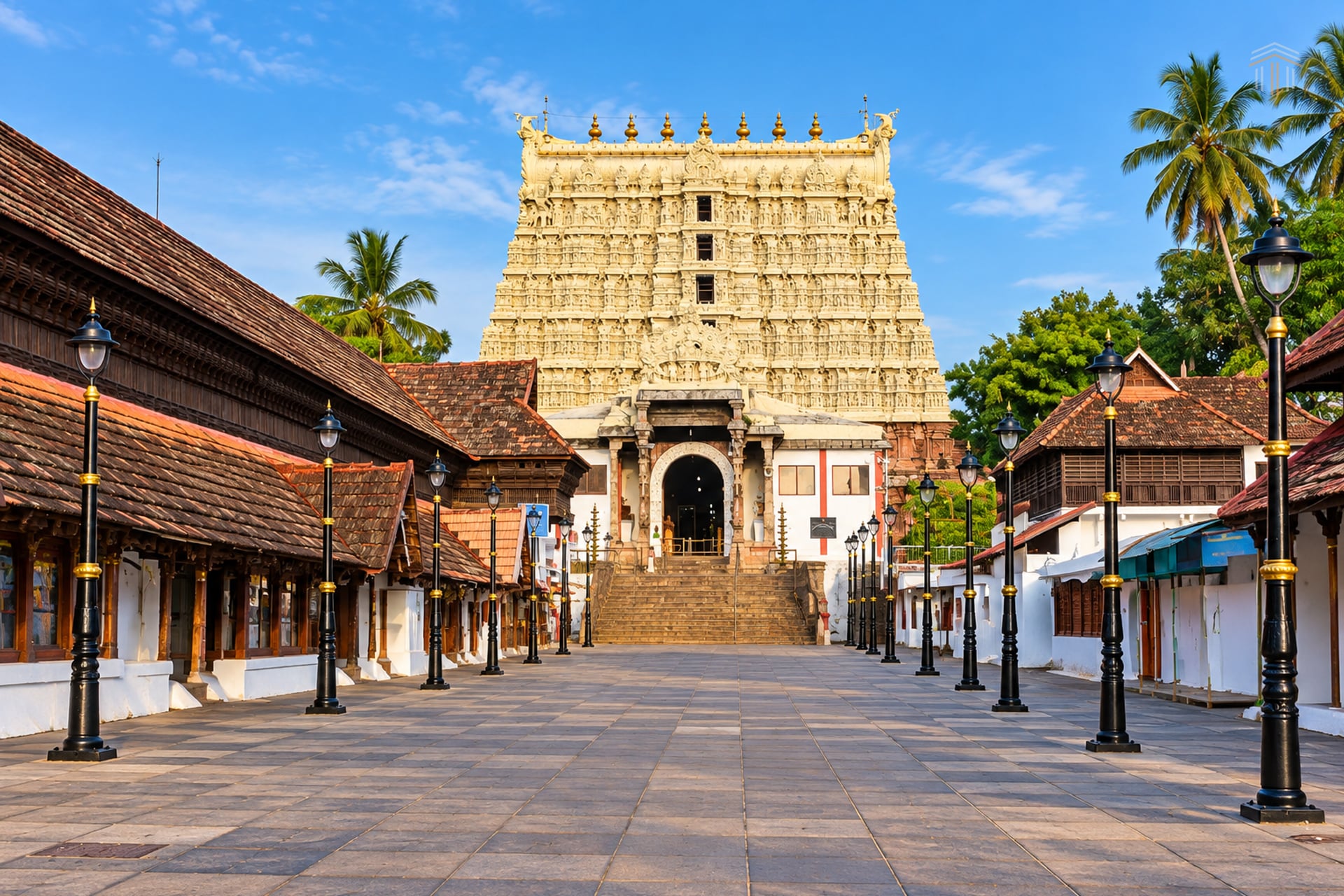
Sree Padmanabhaswamy Temple in Thiruvananthapuram is a sacred Vishnu shrine renowned for its Dravidian architecture, rich history, spiritual significance and legendary hidden treasures.
- ReligionHindu
- DeityLord Padmanabhaswamy (Lord Vishnu in reclining posture)
- TimingsMorning: 03:30 AM - 12:00 PM, Evening: 04:30 PM - 07:20 PM
About the temple
About the temple
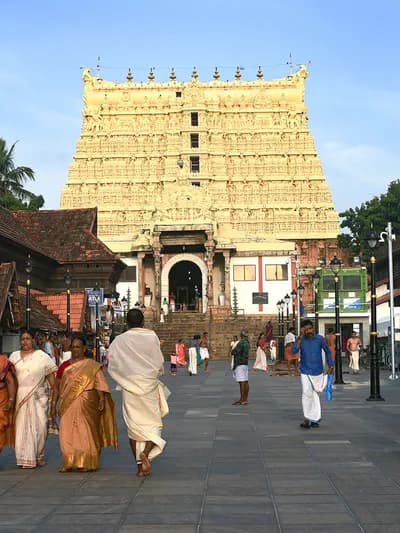
Shri Padmanabhaswamy Temple, located in Thiruvananthapuram, Kerala, is an ancient and highly revered Hindu temple dedicated to Lord Vishnu, enshrined in the unique Anantha Shayana posture on the serpent Adi Shesha. Known for its magnificent Dravidian architecture, strict traditions, and association with the Travancore royal family, the temple is also famous worldwide for its hidden treasures and spiritual grandeur. It holds a special place among the 108 Divya Desams and follows age-old rituals with great sanctity.
Shri Padmanabhaswamy Temple
Shri Padmanabhaswamy Temple
The Living Legacy of Shri Padmanabhaswamy Temple in Numbers
Step into the sacred and opulent world of Shri Padmanabhaswamy Temple-an architectural wonder, a treasury of divine wealth, and a timeless center of Vaishnavite worship. Rooted in legend and sustained by centuries of devotion, the temple stands as a beacon of Kerala’s spiritual and royal heritage.
- Estimated Age of the Temple's Core Structure
- 1000+ yrs
- Estimated Value of Treasures Found in Underground Vaults
- $20B+
- Length of the Idol of Lord Padmanabha in Reclining Posture
- 18 ft
- Sacred Doors Through Which the Deity is Viewed
- 3
- Number of Tiers in the Eastern Gopuram (Temple Tower)
- 7 Tiers
- Number of Mysterious Underground Vaults
- 6
- Kingdom Officially Dedicated to the Deity (Travancore)
- 1
- Approximate Height of the Eastern Gopuram (Temple Tower)
- 100 ft
Estimated Age of the Temple's Core Structure
Estimated Value of Treasures Found in Underground Vaults
Length of the Idol of Lord Padmanabha in Reclining Posture
Sacred Doors Through Which the Deity is Viewed
Number of Tiers in the Eastern Gopuram (Temple Tower)
Number of Mysterious Underground Vaults
Kingdom Officially Dedicated to the Deity (Travancore)
Approximate Height of the Eastern Gopuram (Temple Tower)
Historical Background
Sri Padmanabhaswamy Temple in Thiruvananthapuram has a long history, with references to the shrine dating to the early medieval period. The temple is one of the 108 Divya Desams dedicated to Lord Vishnu. Its present form was largely shaped by major renovations carried out under Maharaja Marthanda Varma in the 18th century. In 1750, he dedicated the Kingdom of Travancore to Lord Padmanabha through the Thrippadidanam ceremony and adopted the title Padmanabha Dasa, meaning servant of Lord Padmanabha. The temple thereafter remained closely associated with the Travancore royal family and the history of the region.
Prehistoric Era
Prehistoric Era
The temple’s exact date of origin cannot be established with certainty. Traditional accounts associate it with an ancient pre-Vedic period, but this claim is not supported by historical evidence. The earliest documented reference to the temple dates to 1304 CE, recorded in the Mathilakam palm-leaf records.Sangam Age (1st Century CE)
Sangam Age (1st Century CE)
The temple region was governed by Ay dynasty rulers during the Sangam period. The temple and its associated city are referenced in early texts as "Syanandoora" (Varaha Purana) and "Anantasayana Puram" (Brahma Purana), indicating an established Vishnu shrine and pilgrimage site.10th Century CE
10th Century CE
The Ay dynasty collapsed, and the Venad kings took control of the temple.1050 CE
1050 CE
The ruling Venad king carried out a renovation of the temple.1335 CE
1335 CE
An earlier King Marthanda Varma (distinct from the 18th-century Travancore founder of the same name) took control of the temple.1461 CE
1461 CE
Following extensive renovation, a reinstallation ceremony of the deity was performed.1566 CE
1566 CE
The foundation of the temple's present gopuram (seven-tier, 100 ft, Pandyan-style) was laid, under Venad rule - predating the Travancore kingdom.1673-1677 CE
1673-1677 CE
A civil war in Venad forced the temple to close, with no rituals conducted during this period.1686 CE
1686 CE
A major fire damaged the temple, gutting most of the structure and collapsing the sanctum roof, though the idol itself was undamaged.1729-1758 CE
1729-1758 CE
Anizham Thirunal Marthanda Varma, founder of the Travancore kingdom, began rebuilding the temple in its present form starting 1729, with idol reconsecration around 1731.1749/1750 CE
1749/1750 CE
Marthanda Varma performed the Thrippadi Danam, dedicating the Travancore kingdom to Lord Padmanabhaswamy and assuming the title "Padmanabha Dasa."20th Century CE
20th Century CE
Temple administration continued under the Travancore royal family as trustees.2011 CE
2011 CE
Following a Supreme Court directive, temple vaults were opened, revealing immense treasures and establishing the temple as one of the world's richest. Five of six vaults were opened; Vault B remained sealed.2020 CE
2020 CE
The Supreme Court of India upheld the Travancore royal family's shebait (custodial) rights over the temple, reversing a 2011 Kerala High Court ruling.


Synopsis
Shri Padmanabhaswamy Temple is a renowned Hindu temple located in Thiruvananthapuram, Kerala, dedicated to Lord Vishnu in his majestic reclining posture as Padmanabhaswamy. Celebrated for its spiritual depth, ancient heritage, and intricate Dravidian-style architecture, the temple is one of the 108 Divya Desams revered in Vaishnavism. It gained international fame for the immense treasures discovered in its underground vaults, making it one of the richest religious institutions in the world. The temple is traditionally managed by the Travancore royal family and follows strict rituals and dress codes. Open only to Hindus, it remains a symbol of devotion, cultural legacy, and architectural excellence in Kerala.
Shri Padmanabhaswamy Temple is steeped in divine lore and is believed to be one of the oldest places of Vishnu worship in India. As per legend, the temple's origin is linked to the Tulu Brahmin sage Vilvamangalathu Swamiyar, who had a divine vision of Lord Vishnu in his cosmic form-Anantha Shayana (reclining on the serpent Adi Shesha). The Lord appeared at Ananthankadu, a wooded grove where the sage witnessed the deity’s vast form stretching across several kilometers. On the sage’s request, the Lord condensed into the form worshipped today. The sanctified ground became the site of the Padmanabhaswamy Temple. This legend connects the temple spiritually to the Ananthapura Lake Temple in Kasaragod, considered its original seat (Moolasthanam). References to the temple region, then known as Syanandurapuram, appear in Sangam literature, and the shrine is regarded as one of the 108 Divya Desams, sacred Vishnu temples mentioned in Tamil Vaishnavite texts, affirming its spiritual antiquity.
The temple’s historical stature was significantly elevated during the rule of the Travancore royal family, especially under King Marthanda Varma (1729-1758 CE). In 1749, he famously performed the Thrippadi Danam, ceremonially dedicating the Travancore kingdom to Lord Padmanabhaswamy and assuming the title “Padmanabha Dasa” (Servant of Padmanabha). From that point, the deity was regarded as the nominal ruler of Travancore, with the kings acting as mere stewards. The royal family invested heavily in the temple’s administration, architectural expansion, and ritual practices, turning it into a center of power, spirituality, and culture in Kerala. This fusion of theocratic kingship and religious devotion is unparalleled in Indian temple history.
The temple evolved architecturally in the Dravidian style, fused with Kerala temple elements, including a majestic seven-tier gopuram, granite-clad sanctum, and pillared corridors. The idol of Lord Padmanabhaswamy, made of a rare combination called Katu-Sharkara-Yogam, is over 18 feet long and viewed through three doors-each revealing a different segment of the deity. Rituals follow the Pancharatra Agama, and priests from both Kerala and Tamil traditions serve in the temple. Over centuries, the temple became a repository of religious music, classical arts, and strict ritual discipline.
The Shri Padmanabhaswamy Temple has six underground vaults, labeled A through F. Vaults C, D, E, and F had been opened periodically over the years as part of temple rituals. Vault A, however, was opened only after the 2011 Supreme Court order, and it yielded the largest and most valuable trove found in the temple - including gold coins, jewelry, and precious stones. Vault B remains sealed to this day, owing to a mythical curse/taboo associated with its opening, and it has not been opened despite the 2011 inventory drive.
In a landmark 2020 verdict, the Supreme Court of India restored administrative control of the temple to the Travancore royal family, affirming their traditional role as custodians and recognizing the temple as a unique example of living religious heritage. Despite modern challenges, Shri Padmanabhaswamy Temple continues to function with spiritual intensity, upholding ancient rituals, drawing thousands of devotees, and serving as a symbol of Kerala’s sacred legacy and cultural pride.
Sacred significance
Devotion to Lord Padmanabhaswamy
Shri Padmanabhaswamy Temple is dedicated to Lord Vishnu in His magnificent reclining form, known as Anantha Shayanam, resting upon the serpent Anantha Shesha. The deity represents Lord Vishnu as the preserver of the universe, and devotees seek His blessings for protection, prosperity, peace, and spiritual well-being. The temple is one of the most important Vishnu temples in Kerala and is revered as one of the 108 Divya Desams of Vaishnavism.
The Divine Form of Anantha Padmanabha
The principal deity is worshipped as Anantha Padmanabha, with Lord Vishnu reclining upon the cosmic serpent Anantha. A lotus emerges from His navel and bears Lord Brahma, symbolising the eternal cycle of creation and preservation. The immense sacred image is viewed through three doors of the sanctum, allowing devotees to see the Lord's face, torso, and feet separately.
Sacred Connection with the 108 Divya Desams
Shri Padmanabhaswamy Temple holds a special place in Sri Vaishnavism as one of the 108 Divya Desams, the sacred Vishnu temples praised in the devotional hymns of the Alvars. This association makes Thiruvananthapuram an important pilgrimage destination for devotees following the Vaishnavite tradition.
Legend of Vilvamangalathu Swami
Temple tradition connects the divine manifestation of Padmanabhaswamy with the great devotee Vilvamangalathu Swami. According to the legend, Lord Vishnu appeared before the sage in the form of a mysterious child and later revealed His magnificent reclining form at Ananthankadu. This story represents the power of devotion and the belief that sincere seekers can experience divine grace.
Sacred Salagrama Stones
The present image of Lord Padmanabhaswamy is traditionally associated with thousands of sacred Salagrama stones, which hold special importance in Vaishnavite worship. Salagramas are revered as sacred manifestations associated with Lord Vishnu, adding another layer of spiritual significance to the principal deity.
Sacred Ananthankadu Tradition
Ananthankadu, associated with the temple's origin legend, is regarded as the sacred place where Vilvamangalathu Swami encountered the divine manifestation of Lord Vishnu. The tradition gives the temple a powerful connection with the idea of divine revelation and makes Ananthankadu an important part of the spiritual heritage of the shrine.
Architecture
Shri Padmanabhaswamy Temple showcases a unique blend of Dravidian and Kerala architectural styles, reflecting the cultural fusion of Tamil and Malayalam traditions. The temple features a towering seven-tier gopuram, intricately carved granite pillars, copper-plated roofs, and a sacred sanctum housing the massive idol of Lord Padmanabha in a reclining posture. Its sanctum sanctorum is believed to follow the Pancharatra Agama and is accessible only to select priests. The temple complex also includes long pillared corridors, a ritual pond (Padma Theertham), and sacred vaults. Rich in symbolism and artistry, the temple is a magnificent example of South Indian temple architecture with regional adaptations.
Gopuram
The Eastern Gopuram (Main Temple Tower)
The seven-tiered Eastern Gopuram, standing approximately 100 feet tall, is built in the Dravidian style, richly adorned with stone carvings of gods, goddesses, mythical creatures, and celestial beings. This grand tower marks the main entrance to the temple complex and reflects influences from Tamil temple architecture. Its foundation was laid in 1566 CE, under Venad rule, predating the Travancore kingdom. The gopuram serves both a symbolic and functional purpose - announcing the temple's sacred presence and guiding pilgrims inward toward the divine.
Sanctum
Garbhagriha (Sanctum Sanctorum)
The Garbhagriha, or sanctum sanctorum, houses the magnificent 18-foot-long idol of Lord Padmanabha, reclining on the five-hooded serpent Adi Shesha. The idol is made using Katusarkara Yogam (an Ayurvedic herbal plaster mixture), and is believed to incorporate 12,008 Shaligram stones sourced from the Gandaki River in Nepal. The deity is viewed through three separate doors - head and shoulders in the first, the navel with Lord Brahma in the second, and the feet in the third - reflecting the cosmic scale of the divine form. The sanctum is a granite structure, accessed only by authorized priests, radiating spiritual intensity and sacredness.
Corridor
Ottakkal Mandapam (Single-Stone Hall)
Located just in front of the sanctum, the Ottakkal Mandapam is a raised platform made from a single block of granite, sourced from a quarry near Thirumala, where important poojas and abhishekams are performed. The slab measures approximately 20 feet square and 2.5 feet thick, exemplifying masterful stone craftsmanship. Traditionally, only the King of Travancore was permitted to prostrate on this platform.
Corridor
Outer Corridors and Flagstaff Mandapam
The temple features long, pillared corridors constructed in traditional Kerala style, lined with intricate wood and stone carvings. These corridors connect various parts of the temple complex. Near the entrance stands the Dwajasthambam (flagstaff), encased in gold-plated covering and located on a stone platform. This area is a focal point during festivals and processions.
Roof
Copper-Plated Roof and Golden Kalasam
The temple's main shrine and adjacent structures are topped with traditional Kerala-style copper-plated roofs, designed to endure monsoon rains and intense heat. Atop the sanctum sits a golden Kalasam (spire), signifying spiritual energy and the divine abode of the deity. These roof structures blend Kerala and Dravidian traditions harmoniously.
Pond
Padma Theertham (Sacred Temple Tank)
Located adjacent to the eastern entrance, the Padma Theertham is one of the oldest temple ponds in Kerala. Surrounded by stone steps and bordered by flowering lotus plants, the tank is used for ritual purification by devotees and priests. The name "Padma Theertham" translates to "Lotus Spring," linking it symbolically with Lord Padmanabha.
Kitchen
Madapalli (Temple Kitchen)
The Madapalli is the temple's sacred kitchen, where offerings for the deity are prepared according to strict ritual guidelines. Built in traditional style using stone hearths and bronze vessels, it upholds centuries-old culinary customs. Food prepared here is considered highly sanctified and is distributed as prasadam.
Treasury
Temple Vaults (Nilavara)
The temple houses six underground vaults (labeled A-F), historically used to store offerings, jewelry, and valuables donated by devotees and rulers over centuries. These vaults are heavily fortified and kept sealed under royal and ritual authority. Vault A, opened following the 2011 Supreme Court order, gained international fame for its unimaginable treasures, including gold coins, antique jewelry, and rare artifacts. Vault B remains sealed to this day.
Pillars
Stone Pillars and Sculptural Artwork
Throughout the temple's mandapams and corridors are exquisitely carved granite pillars, featuring depictions of deities, dancers, Garuda (Vishnu's mount), and scenes from epics like the Ramayana and Mahabharata. These pillars not only support the structure but also serve as canvases of religious storytelling and artistic heritage.
Interesting facts

In 2011, the opening of the temple’s hidden underground vaults revealed an unimaginable treasure trove-gold ornaments, diamonds, ancient coins, and artifacts estimated to be worth over $20 billion, making it one of the richest temples in the world. Vault B remains unopened due to religious and legal sensitivities, adding to the temple's mystique.
Deities & Shrines
Goddess Lakshmi (Sree Devi and Bhoomi Devi)
On either side of Lord Padmanabha in the sanctum, the forms of Goddess Sree Devi (Goddess of Prosperity) and Goddess Bhoomi Devi (Goddess of Earth) are also worshipped. These consorts of Lord Vishnu signify material and earthly prosperity. Devotees offer prayers for abundance, fertility, and stability in life.
Lord Narasimha (Thekkedom Shrine)
A fierce incarnation of Lord Vishnu, Lord Yoga Narasimha is enshrined in a separate sanctum called the Thekkedom shrine, within the temple complex. Worshipped for his power to destroy evil and protect the righteous, Narasimha is venerated by devotees seeking courage and protection from negative forces.
Lord Krishna (Thiruvambadi Shrine)
A shrine for Lord Krishna, another avatar of Vishnu, known as the Thiruvambadi Sree Krishnaswamy Temple, is also present within the complex. Revered especially in his youthful and divine form, Krishna is worshipped for love, wisdom, and joy. This shrine is a focal point during Janmashtami celebrations.
Lord Ganesha
A shrine dedicated to Lord Ganesha, the remover of obstacles, is present within the temple complex. Devotees traditionally offer prayers to Ganesha before approaching the main sanctum, seeking success and the removal of hurdles in their spiritual journey.
Lord Hanuman
Lord Hanuman, the epitome of devotion and strength, is enshrined within the temple complex. His presence is considered auspicious, and devotees seek his blessings for courage, loyalty, and protection from evil.
Darshan & Service Offerings
| Service | Timing | Price | Notes |
|---|---|---|---|
| Nirmalyam to Deeparadhana | 3:30 AM - 4:45 AM | ₹3,000 | This advance-booked ritual package allows devotees to witness the temple's opening rites (Nirmalyam) through the Deeparadhana lamp-offering ceremony, covering the earliest and most sacred sequence of the day's worship. |
| Nirmalyam to Usha Pooja | 3:30 AM - 5:30 AM | ₹4,000 | An extended early-morning package covering the temple's opening rituals through the Usha Pooja (dawn worship), offering devotees a more complete experience of the morning ceremonies. |
| Nirmalyam to Pantheeradi Pooja | 3:30 AM - 6:00 AM | ₹5,000 | This package extends coverage from the temple's opening through the Pantheeradi Pooja, allowing devotees to witness a fuller sequence of the morning's ritual worship. |
| Half-Day Nirmalyam to Ucha Pooja | 3:30 AM - 12:00 PM (half-day package) | ₹12,000 | The most comprehensive advance-booking package, covering the temple's opening rituals through to the midday Ucha Pooja, offering devotees an extended, immersive worship experience across the full morning ritual cycle. |
| General Darshan (Free) | During regular temple hours | Free | Devotees can have darshan of Lord Padmanabha through the three doors of the sanctum during the temple's open hours. Entry is subject to the general queue and traditional dress code compliance. Wait times can be long, especially during peak hours and festivals. |
| Special Darshan | Available during regular darshan hours | ₹150 per person (basic) / ₹180 per person (with prasad) | Special Darshan tickets, purchased at the temple counter, allow devotees to bypass the general queue for quicker access to the sanctum. |
| Special Darshan for Two (with Pooja Thali) | Available during regular darshan hours | ₹250 for two people | A special darshan option for two devotees together, which includes a pooja thali. Entry for accompanying kids is free. |
Visitor information
Location
Shri Padmanabhaswamy Temple is located in the heart of Thiruvananthapuram, the capital city of Kerala. The temple is approximately 2 km from Thiruvananthapuram Central Railway Station and approximately 4 km from Trivandrum International Airport, making it easily accessible for both domestic and international pilgrims.
Traditional Dress Code
The temple strictly enforces a traditional dress code. Men must wear a white or off-white mundu (dhoti) wrapped around the lower body, with the upper body left bare or covered with an angavastram (shawl); a dhoti may also be wrapped over pants or shorts to comply. Women may wear a saree, dhoti/pavada with a blouse, or a t-shirt with a long skirt/lehenga; jeans or a salwar suit are permitted only when a dhoti is wrapped over them. Western attire that doesn't meet these wrap requirements is not permitted.
Photography and Electronics
Photography, videography, and mobile phones are strictly prohibited inside the temple premises. Visitors must deposit mobile phones, cameras, and similar electronic devices at the designated locker/counter before entering. Handbags are generally allowed inside.
Entry for Non-Hindus
Only those who profess the Hindu faith are allowed inside the temple complex, regardless of nationality. Non-Hindus can view the temple architecture from outside but are not permitted to enter the inner sanctum or participate in rituals.
Best Time to Visit
The ideal time to visit for pleasant weather is between October and February. Major festivals fall slightly outside this window too - Alpasi Utsavam in October/November aligns well, while Painkuni Utsavam takes place in March/April. Early morning (around the 3 AM Nirmalya Darshanam) or evening hours are best for a peaceful, less crowded darshan.
Devotee Facilities
The temple offers a shoe rack near the main entrance and a locker room for depositing mobile phones, cameras, and other electronics.
Location
Thiruvananthapuram, Kerala, India
Best Time to Visit
Best Time to Visit Padmanabhaswamy Temple
The most pleasant time to visit is between October and February, when Trivandrum experiences cooler, less humid weather ideal for sightseeing and temple visits.
Visit During Major Festivals
Plan your visit during grand festivals like Alpashy Festival (October-November) and Painkuni Festival (March-April). The temple comes alive with colorful rituals, traditional processions, and cultural performances.
Quieter Visits During Monsoon
The June to September monsoon season sees fewer tourists. Though humid, it’s a good time for a peaceful, crowd-free darshan if you don’t mind the occasional rainfall.
Early Morning Darshan
Visiting the temple at dawn between 3:30 AM and 6:30 AM offers a spiritually uplifting experience. This is when key rituals like Nirmalya Darshan and Abhishekam are performed, with fewer crowds.
Nearby places
Attukal Bhagavathy Temple
2 km
- Dedicated to Goddess Kannaki (an incarnation of Parvati), this temple is famous for the annual Attukal Pongala, one of the largest religious gatherings of women in the world. It is a powerful Shakti Peetha and holds immense cultural significance in Kerala.
Pazhavangadi Ganapathy Temple
1 km (about a 6-minute walk from Padmanabhaswamy Temple)
- Located near East Fort, this temple is dedicated to Lord Ganesha. It is renowned for its unique practice of coconut-breaking as a form of offering. The temple is maintained by the Indian Army and is a key spiritual stop for devotees in the area.
Festivals & culture
Festivals at Shri Padmanabhaswamy Temple are deeply rooted in ancient traditions and royal heritage. The temple comes alive during grand celebrations like Alpasi and Painkuni festivals, marked by majestic processions, Vedic rituals, and elaborate offerings. One of the most spiritually significant events is Murajapam-Lakshadeepam, held once every six years - a 56-day Vedic chanting ritual that culminates with over 100,000 oil lamps illuminating the temple premises in a breathtaking display of devotion. Each festival blends religious fervor with classical music, dance, and cultural displays, attracting thousands of devotees from across the country. These events reflect the temple's enduring legacy and its vibrant role in Kerala's spiritual calendar.
Alpasi Festival
October-November (Thulam month of the Malayalam calendar)
This ten-day festival includes special rituals, processions, and cultural performances. It concludes with the grand Aarat procession to Shanghumugham Beach.
Painkuni Festival
March-April (Meenam month of the Malayalam calendar)
One of the most prominent festivals, marked by massive figures of the Pandavas erected at the eastern entrance, concluding with the ceremonial Aarat bath of the deity at the sea.
Murajapam-Lakshadeepam
Once every 6 years - most recently held November 21, 2025 to January 14, 2026; next occurrence expected around 2031-2032
A 56-day Vedic ritual involving continuous chanting of the Rig, Yajur, Sama, and (most recently) Atharva Vedas by scholars from across the country. It culminates in Lakshadeepam, when the temple and its surroundings are illuminated with over 100,000 oil lamps, accompanied by a grand procession of the deities Padmanabhaswamy, Narasimha, and Thiruvambadi Krishna.
Vaikunta Ekadasi
December-January (Margazhi month)
An important day in the Vaishnavite calendar, when devotees believe the Vaikunta Dwaram (Heaven's Gate) is opened.
Additional information
Official Temple Website
For more details, visit the official website of Sree Padmanabhaswamy Temple at Official Website.
Temple Opening Hours
The temple is open from approximately 3:15/3:30 AM to 12:00 PM and again from 5:00 PM to 7:20 PM daily, with a midday closure between 12:00 PM and 4:00 PM. Timings may vary slightly during special occasions and festivals.
Traditional Dress Code
Strict dress code is enforced. Men must wear mundu (dhoti) without shirts or vests, with the upper body bare or covered with an angavastram (shawl). Women must wear a saree, set-mundu, or long skirt with blouse. Pants, jeans, and modern attire are not permitted as standalone wear.
Footwear Restrictions
Footwear is strictly prohibited inside temple premises. A shoe rack is available near the main entrance for storage.
Advance Registration Required
Darshan requires advance registration through the temple's official portal, spst.in, or in person at a counter near the entrance. Devotees must carry their original Aadhaar card during their visit for verification.
Temple facilities
Drinking Water Facilities
As part of a Kerala Tourism infrastructure improvement project ("Swadeshi Darshan Tourism"), drinking water fountains were planned for installation at multiple points around the temple complex.
Public Toilets
The same infrastructure project included the construction of toilet blocks around the temple premises.
Signage, Dustbins, and Information Centre
The project plan also included signage boards, uniform name boards, dustbins around the complex, a new information centre, and a digital museum.
Stone-Paved Heritage Walk
A planned 5.2 km stone-paved heritage walk was designed to allow visitors to view all four gateways of the temple, alongside renovation of the pathways adjacent to Padmatheertham tank.
Emergency services
SP Fort Health Plus
0.2 km
Contact
+91 4712450850
- SP Fort Health Plus is approximately 0.2 km from Shri Padmanabhaswamy Temple, making it a very convenient nearby healthcare option for devotees and visitors.
SP Medifort Hospital
2 km
Contact
+91 4713100100
- A leading private hospital offering advanced medical care, emergency services, and specialized treatment. Known for excellent facilities and international patient care standards.
Top picks
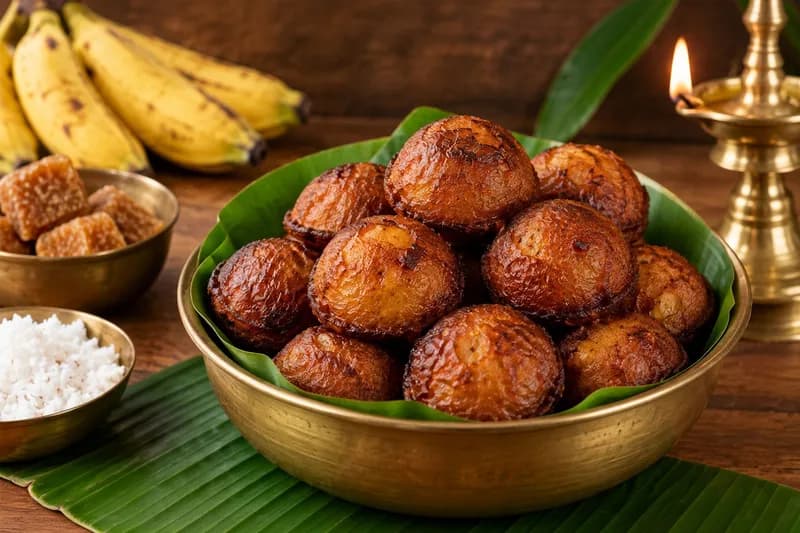
Unniyappam
A popular prasadam at Shri Padmanabhaswamy Temple, Unniyappam is a deep-fried sweet snack made of rice flour and jaggery. It’s soft inside, crispy outside, and infused with the fragrance of ghee and banana.
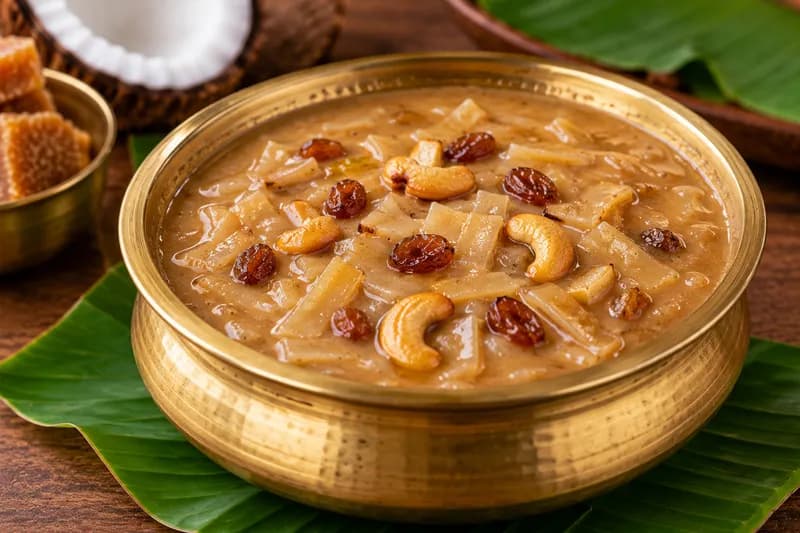
Ada Pradhaman
A rich, dessert-style payasam made during festive occasions. It's creamy, mildly spiced, and deeply flavorful.
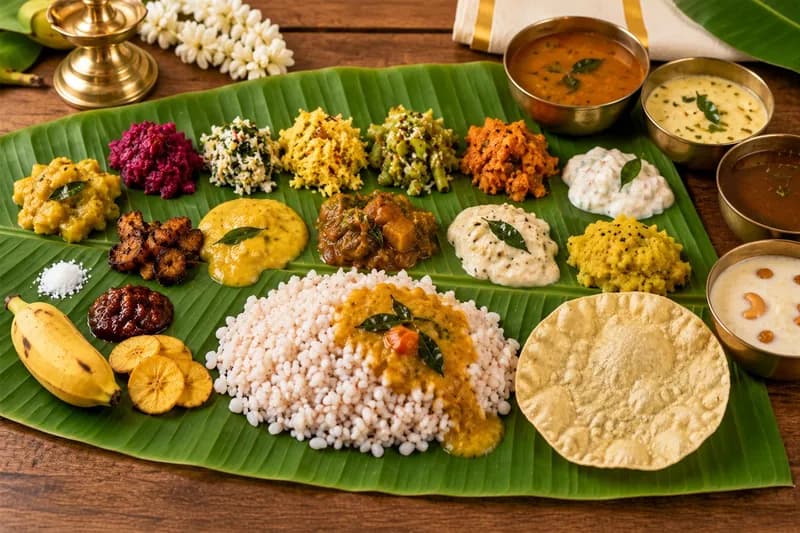
Kerala Sadya
Includes rice, sambar, aviyal, thoran, olan, pachadi, pappadam, and payasam. A must-try meal experience reflecting Kerala’s culinary richness.
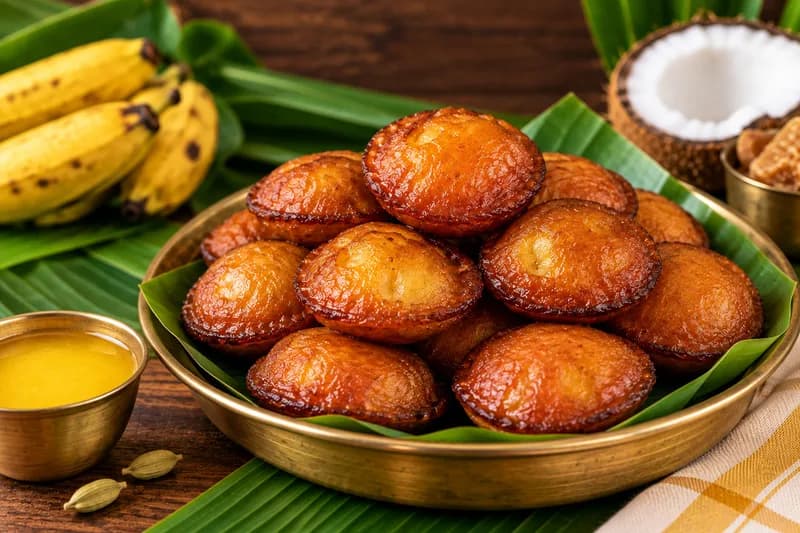
Nei Appam (Ghee Appam)
Another sweet delicacy offered in many Vishnu temples in Kerala. Made in ghee, Nei Appam is a festival favorite and often given as temple prasadam.
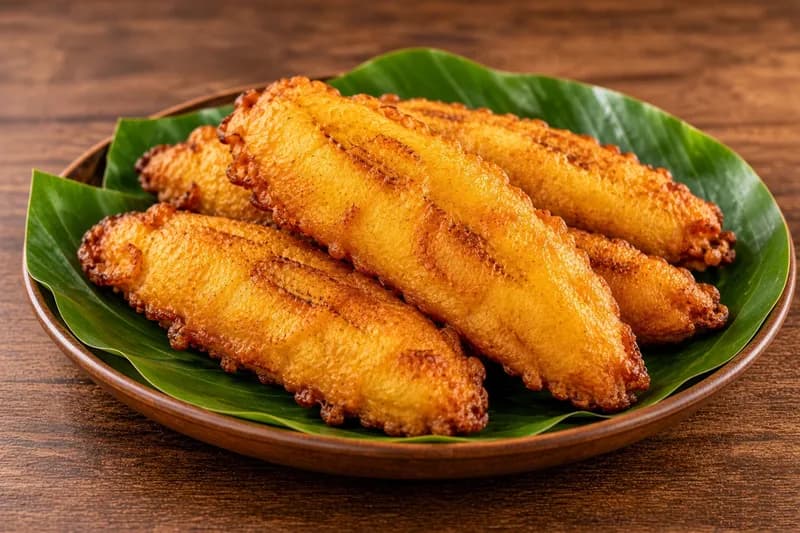
Pazham Pori (Banana Fritters)
A beloved local tea-time snack, crunchy outside and sweet inside, often enjoyed with a cup of Kerala tea.
Visitor guide
Kerala State Road Transport Corporation
0.7 km
- Closest local bus terminal to the temple. Temple is a short walk from this point.
Videos
Third-party videos may include ads or external commentary.
Frequently Asked Questions
Shri Padmanabhaswamy Temple is located in Thiruvananthapuram, Kerala, India. It is one of the most revered Vishnu temples in Kerala and an important pilgrimage destination.
Shri Padmanabhaswamy Temple is famous for its ancient history, magnificent Kerala and Dravidian-style architecture, rich traditions, and the reclining idol of Lord Vishnu. The temple is also widely known for its historically significant underground vaults.
The main deity of Shri Padmanabhaswamy Temple is Lord Padmanabha, a form of Lord Vishnu. The deity is depicted reclining on the serpent Ananta or Adi Shesha.
The idol of Lord Padmanabhaswamy is depicted reclining on the serpent Ananta, with Lord Brahma emerging from a lotus connected to the deity. The unique idol can be viewed through three separate doors of the sanctum.
Shri Padmanabhaswamy Temple has ancient origins and is mentioned in traditional Hindu texts and legends. The present temple complex was significantly developed under the Travancore royal family and became closely associated with the history and culture of the region.
The temple combines traditional Kerala-style and Dravidian architectural features. Its prominent seven-tiered gopuram, detailed stone carvings, ornate corridors, monumental pillars, and traditional murals contribute to its distinctive architectural character.
Shri Padmanabhaswamy Temple is generally open to devotees during designated morning and evening darshan hours, with breaks for daily rituals and poojas. Timings can change during festivals and special occasions, so visitors should check the latest schedule before visiting.
Yes, Shri Padmanabhaswamy Temple follows a traditional dress code for devotees. Men are generally required to wear a traditional dhoti or similar permitted attire, while women should wear traditional or otherwise approved clothing. Visitors should check the current temple guidelines before entering.
Important festivals at Shri Padmanabhaswamy Temple include Alpashy Festival, Painkuni Festival, Laksha Deepam, and Navaratri-related celebrations. These occasions feature special rituals, processions, and religious ceremonies.
Shri Padmanabhaswamy Temple is located in the heart of Thiruvananthapuram and is easily accessible by road, rail, and air. Thiruvananthapuram Central Railway Station is close to the temple, while Thiruvananthapuram International Airport is the nearest airport.